Radxa Penta SATA HAT
Radxa ROCK Penta SATA HAT is an addon HAT designed for ROCK Series. It utilizes the high speed PCIe buses on ROCK Series and provides a complete NAS solution based on ROCK Series.
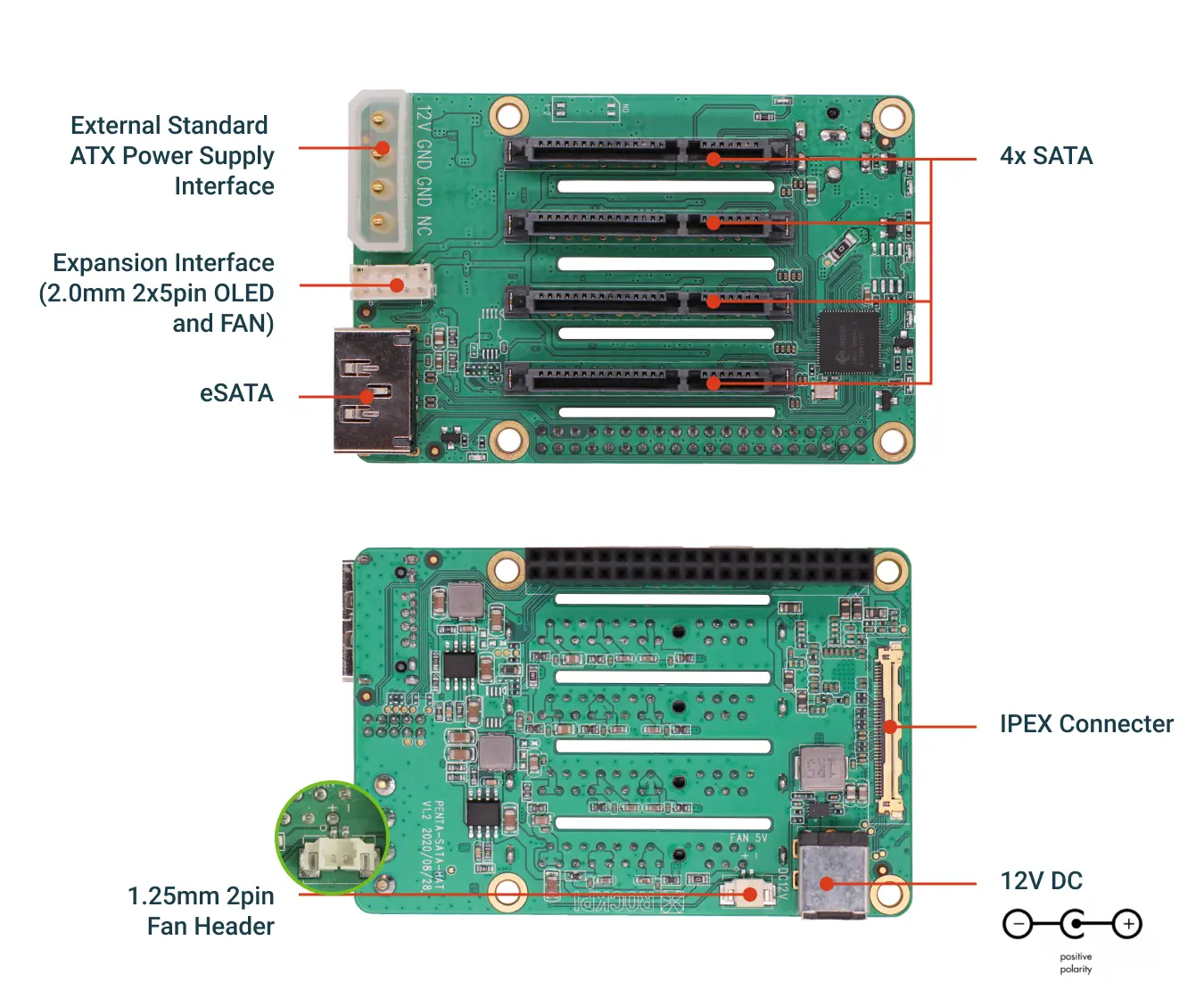
Currently supported Radxa ROCK Series products:
- ROCK 2A
- ROCK 2F
- ROCK 3A
- ROCK 3C
- ROCK 4A / 4B
- ROCK 4A+ / 4B+
- ROCK 4D
- ROCK 4SE
- ROCK 5A
- ROCK 5C
ROCKPi 4 Series vs. ROCK 4 Series Compatibility Note: ROCKPi 4 series is the early product name, now unified as the ROCK 4 series.
- ROCKPi 4A = ROCK 4A
- ROCKPi 4B = ROCK 4B
- ROCKPi 4A+ = ROCK 4A+
- ROCKPi 4B+ = ROCK 4B+
- ROCKPi 4SE = ROCK 4SE
ROCK 4A/4A+/4B/4B+/4SE are fully compatible with ROCKPi 4A/4A+/4B/4B+/4SE and all are fully compatible with Penta SATA HAT. If your device is labeled as ROCKPi 4A/B/4SE, please refer to the installation guide for the corresponding ROCK 4A/B/4SE.
Currently supported Raspberry Pi models:
- Raspberry Pi 5
Feature
- Up to 5x HDD/SSD, support 2.5inch or 3.5inch SSD, up to 100T Storage
- 4x SATA + 1x eSATA with power
- Utilize PCIe buses on ROCK Series and Raspberry Pi
- External standard ATX power supply support for HDDs and SBC itself
- 12V DC power input for 2.5/3.5 HDD power and SBC itself (polarity: center positive)
- Support HDD suspend mode
- Support software RAID 0/1/5
- Optional PWM control fan for HDD heat dispatching
- Optional OLED display for IP/Storage info
If you use large capacity 3.5-inch mechanical hard drives on the Penta SATA HAT, you need to check the hard drive specification to determine the peak current of the hard drive. The peak current of the hard drive must be less than 2.2A.
Package List
-
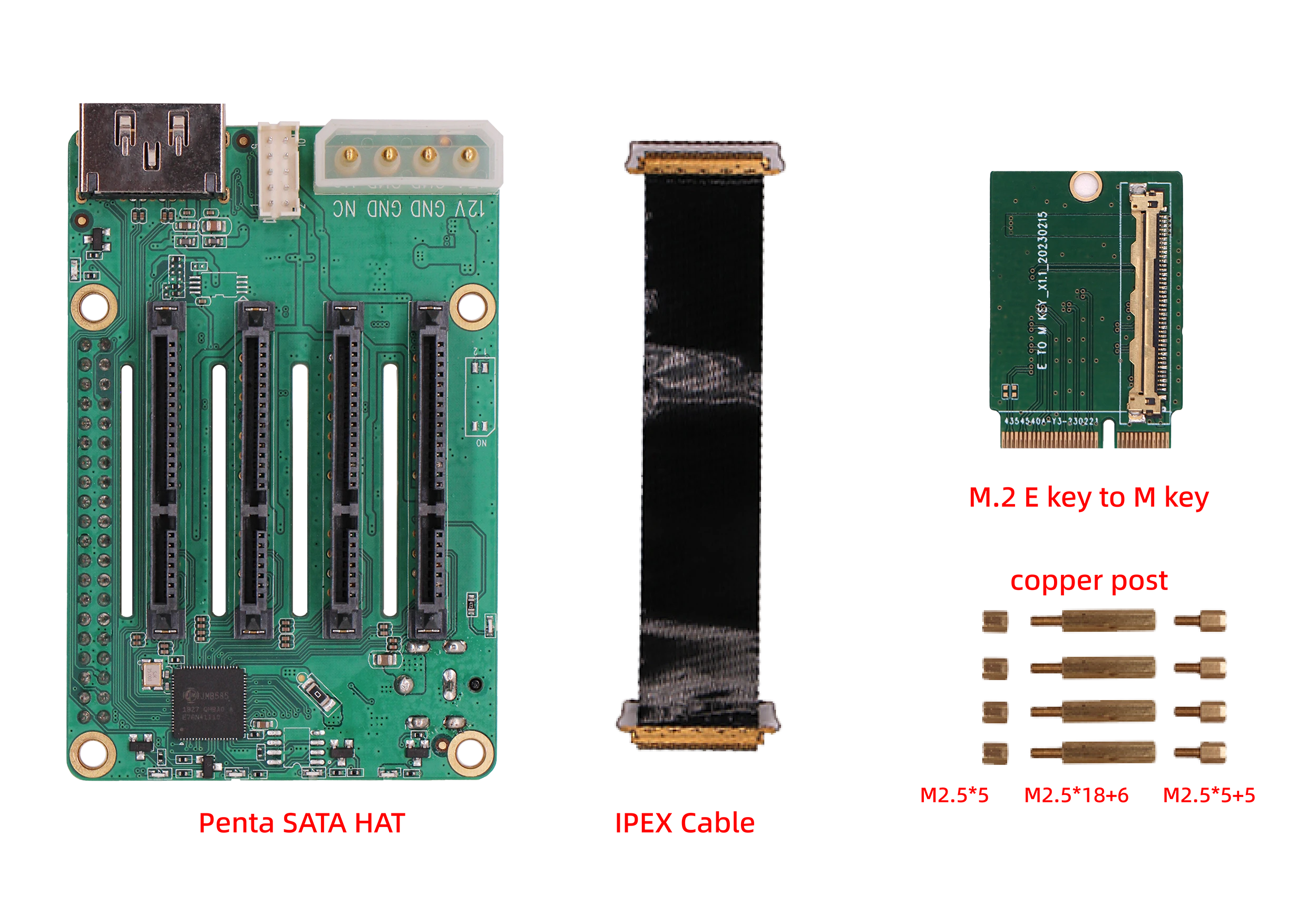
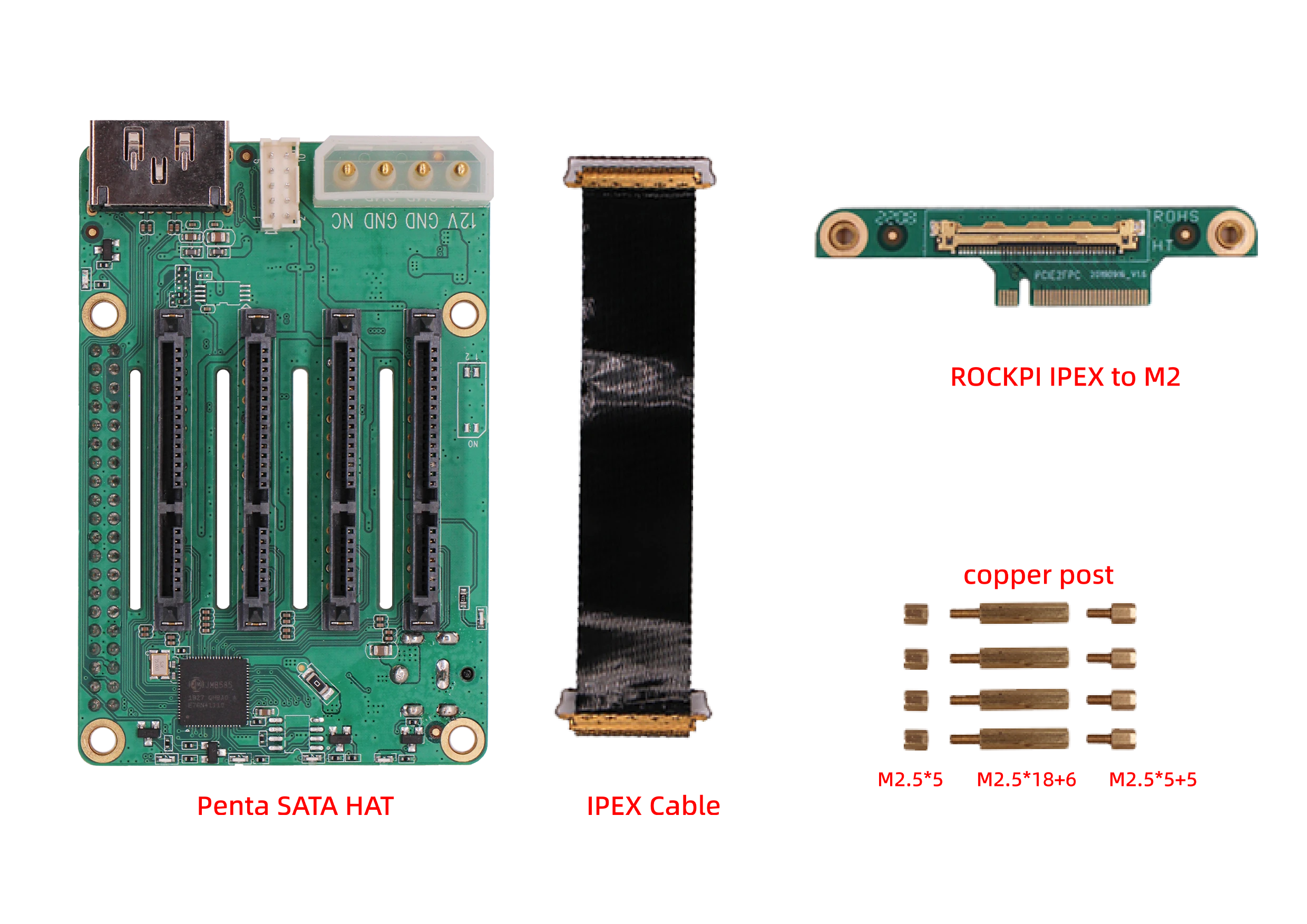
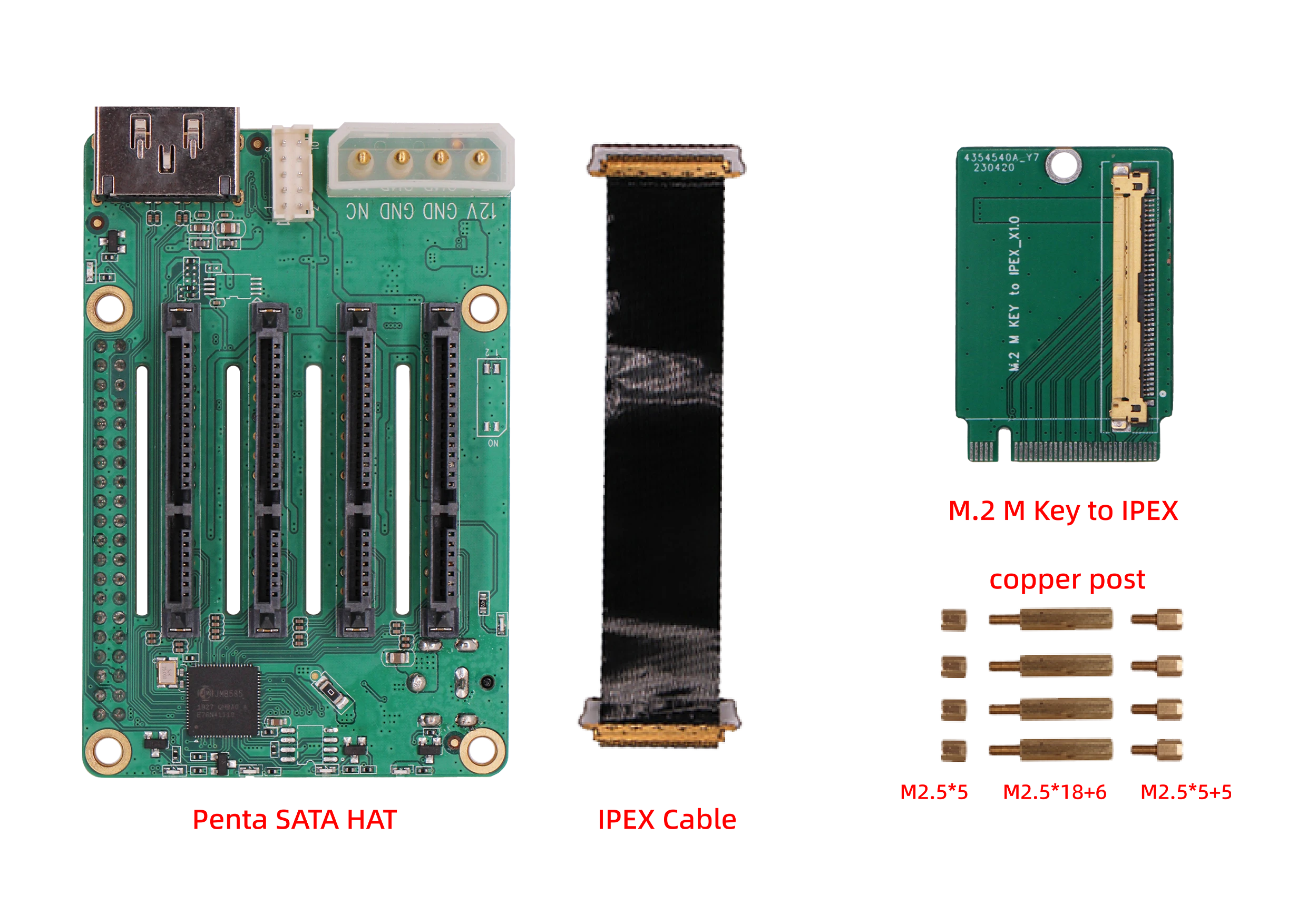
Radxa ROCK Penta SATA HAT
-
Copper Pillar for fixing
-
Adapter Board
-
IPEX Cable
-
Penta SATA HAT Kit with ROCK 5A support
-
Penta SATA HAT with ROCK 3A / 4A / 4B / 4A+ / 4B+ / 4SE support
-
Penta SATA HAT with ROCK 3C support
Components and troubleshooting scope
The Penta SATA HAT family is commonly used in the following combinations:
- Base board: the storage board used for SATA connectivity
- Top board (optional): adds the OLED display and fan; see Penta SATA HAT top board
- Full kit: base board + top board + the matching accessories
If you run into installation or boot problems, identify which combination you are using before troubleshooting further:
- With only the base board connected, first confirm the system image, kernel version, and whether the SATA devices are detected
- Install the
rockpi-pentapackage only when the top board is present, because it is used for the OLED and fan features - If the system becomes unstable after connecting the IPEX cable, record the board model, whether you are using the base board or the full kit, and any serial or kernel logs
40Pin Pinout
| Description | Function | Pin# | Pin# | Function | Description |
|---|---|---|---|---|---|
| 1 | 2 | VCC | |||
| OLED I2C | I2C_SDA | 3 | 4 | VCC | |
| OLED I2C | I2C_SCL | 5 | 6 | GND | |
| 7 | 8 | ||||
| GND | 9 | 10 | |||
| top board key | GPIO | 11 | 12 | ||
| 13 | 14 | GND | |||
| 15 | 16 | GPIO | reset OLED | ||
| 17 | 18 | ||||
| 19 | 20 | GND | |||
| 21 | 22 | ||||
| 23 | 24 | ||||
| GND | 25 | 26 | |||
| 27 | 28 | ||||
| 29 | 30 | GND | |||
| 31 | 32 | ||||
| tb-fan speed | PWM | 33 | 34 | GND | |
| 35 | 36 | ||||
| 37 | 38 | ||||
| GND | 39 | 40 |
2x5 Pin Pinout
| Pin | Signal | Pin | Signal |
|---|---|---|---|
| 1 | I2C_SDA | 2 | VCC3V3_SYS |
| 3 | I2C_SCL | 4 | VCC5V0_SYS |
| 5 | GPIO4_D2 | 6 | GPIO4_C2 |
| 7 | GND | 8 | PWM_33 |
| 9 | GND | 10 | NC |
Technical Specifications:
- Connector Type: 2x5 pin header
- Pitch: 2.0mm
- Compatible Connectors: Standard 2.0mm pitch 2x5 pin header (2x5 pin header, 2.0mm pitch)
Onboard Fan Header
The Penta SATA HAT base board provides a 2-pin fan header right next to the 12V DC power jack (on the underside of the board). Its specification is as follows:
- Connector Type: JST GH 1.25mm 2-pin male header
- Pitch: 1.25mm
- Compatible Connector: JST GH 1.25mm 2-pin female connector (wire-to-board)
- Output Voltage: Fixed 5V (5V + GND) - use a 5V fan and check polarity before powering on
- Control: Non-PWM, always on when powered; for PWM fan speed control, use the optional Penta SATA HAT top board (PWM signal via the 2x5 header)
Do not force a 2.0mm pitch plug (e.g. JST PH) into this header - 1.25mm and 2.0mm are not interchangeable.
User Guide
📄️ Raspberry Pi 5 Use Penta HAT
The Raspberry Pi 5 has a PCIe port that works well with the Radxa Penta SATA HAT.
📄️ Penta SATA HAT top board
The Radxa Penta SATA HAT has a 2x5 seat with the following signal:
📄️ Create RAID Arrays with mdadm
mdadm is a Linux software RAID tool that can be used to create, manage, and monitor software RAID arrays. In this guide, we will show you how to create RAID 0, RAID 1, RAID 5 and RAID 10 arrays using mdadm.