Radxa Dragon Q6A
Product Overview
The Radxa Dragon Q6A is a high-performance, low-power embedded computing platform based on the Qualcomm® QCS6490 processor, designed specifically for industrial IoT, edge AI, and smart devices.
The Dragon Q6A is equipped with the Qualcomm QCS6490 SoC, featuring a “1+3+4” tri-cluster design (1× Kryo Prime @ 2.7GHz, 3× Kryo Gold @ 2.4GHz, 4× Kryo Silver @ 1.9GHz), balancing high performance with low power consumption; It integrates the Qualcomm® Adreno 643 GPU, VPU, and AI accelerator, offering advanced AI acceleration capabilities and multimedia processing capabilities.
Product Appearance
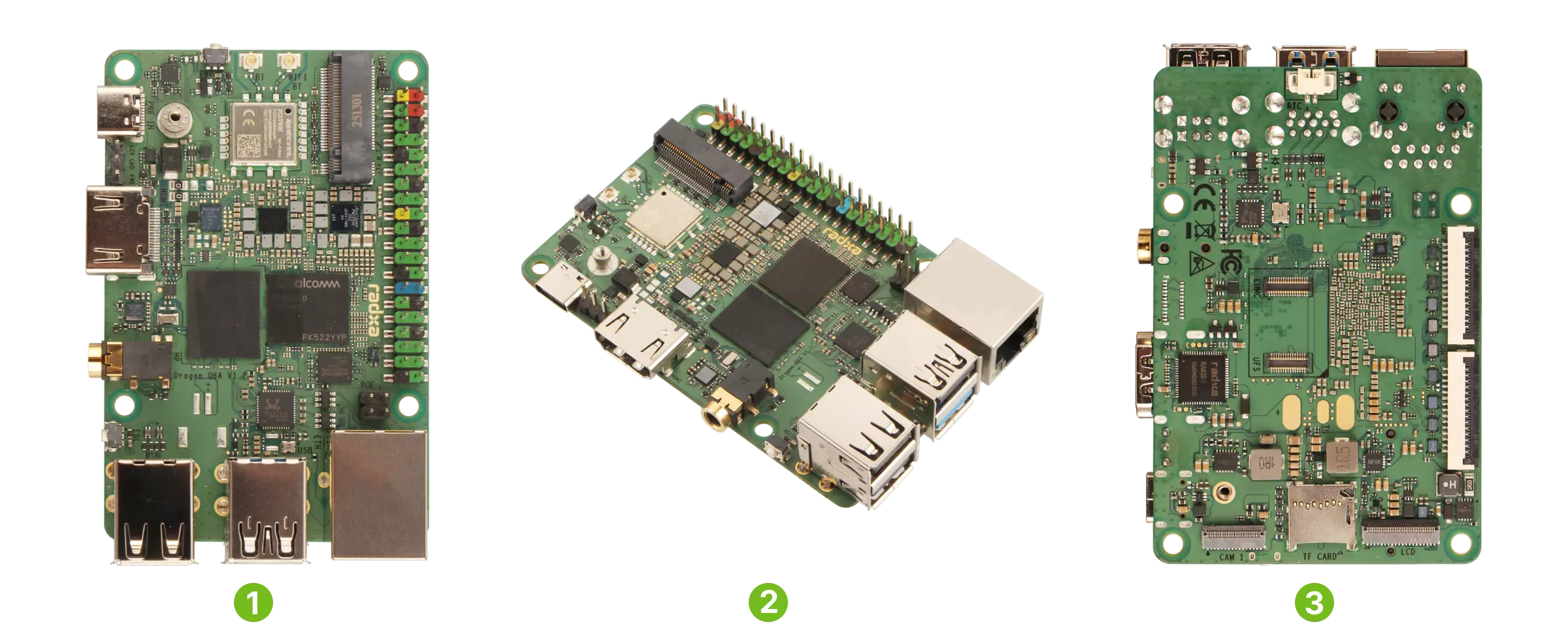
| No. | View | No. | Side View | No. | Back View |
|---|---|---|---|---|---|
| ① | Dragon Q6A Front | ② | Dragon Q6A Side | ③ | Dragon Q6A Back |
Product Specifications
| Category | Specification Description |
|---|---|
| Core Platform | System-on-Chip (SoC): Qualcomm QCS6490 Central Processing Unit (CPU): 1x Kryo Gold Plus @2.7GHz + 3x Kryo Gold @2.4GHz + 4x Kryo Silver @1.9GHz Graphics Processing Unit (GPU): Qualcomm® Adreno 643, supporting OpenGL ES 3.2, Vulkan 1.3, OpenCL 2.0, DirectX 12 AI Accelerator: Hexagon DSP + Hexagon Tensor Accelerator, with a combined AI computing power of up to 12 TOPS Video Processing Unit (VPU): Supports up to 4K@60fps decoding (H.264/H.265/VP9) and 4K@30fps encoding (H.264/H.265), with HDR10/HDR10+ playback capability |
| Memory | LPDDR5, Options: 4GB / 6GB / 8GB / 12GB / 16GB |
| Storage | Boot Storage: Onboard 32MB QSPI Nor Flash Expandable Storage: Supports microSD card / eMMC module / UFS module / M.2 M Key 2230 NVMe SSD |
| Networking | Wired Connection: 1x Gigabit Ethernet port (PoE support requires an external PoE HAT) Wireless Connection: Wi-Fi 6, Bluetooth 5.4 (requires external antenna) |
| Video Output | HDMI: 1x HDMI port, supporting up to 4K@30Hz MIPI DSI: 1x 4-lane MIPI DSI |
| Camera | 1x 4-lane MIPI CSI 2x 2-lane MIPI CSI |
| Audio | Audio Interface: 3.5mm 4-segment headphone jack, supporting microphone input Audio Output: Supports stereo output and can directly drive 32Ω headphones |
| USB | USB 3.1:1× Type-A HOST / OTG USB 2.0:3× Type-A HOST |
| Expansion | 40-Pin GPIO Header: Supports UART, SPI, I2C, etc. RTC battery connector: 1× 2-pin 1.25mm Buttons: Power button, EDL button |
| Power Supply | Supports USB Type-C 12V power input Supports external 12V pin power input Supports PoE power supply (requires an external PoE HAT) |
| Supported OS | Ubuntu Linux Qualcomm Linux(Based on Yocto Development) Android 15 (CS) or Android 16 (ES) System |
| Dimensions | 85 mm x 56 mm |
Interface Description
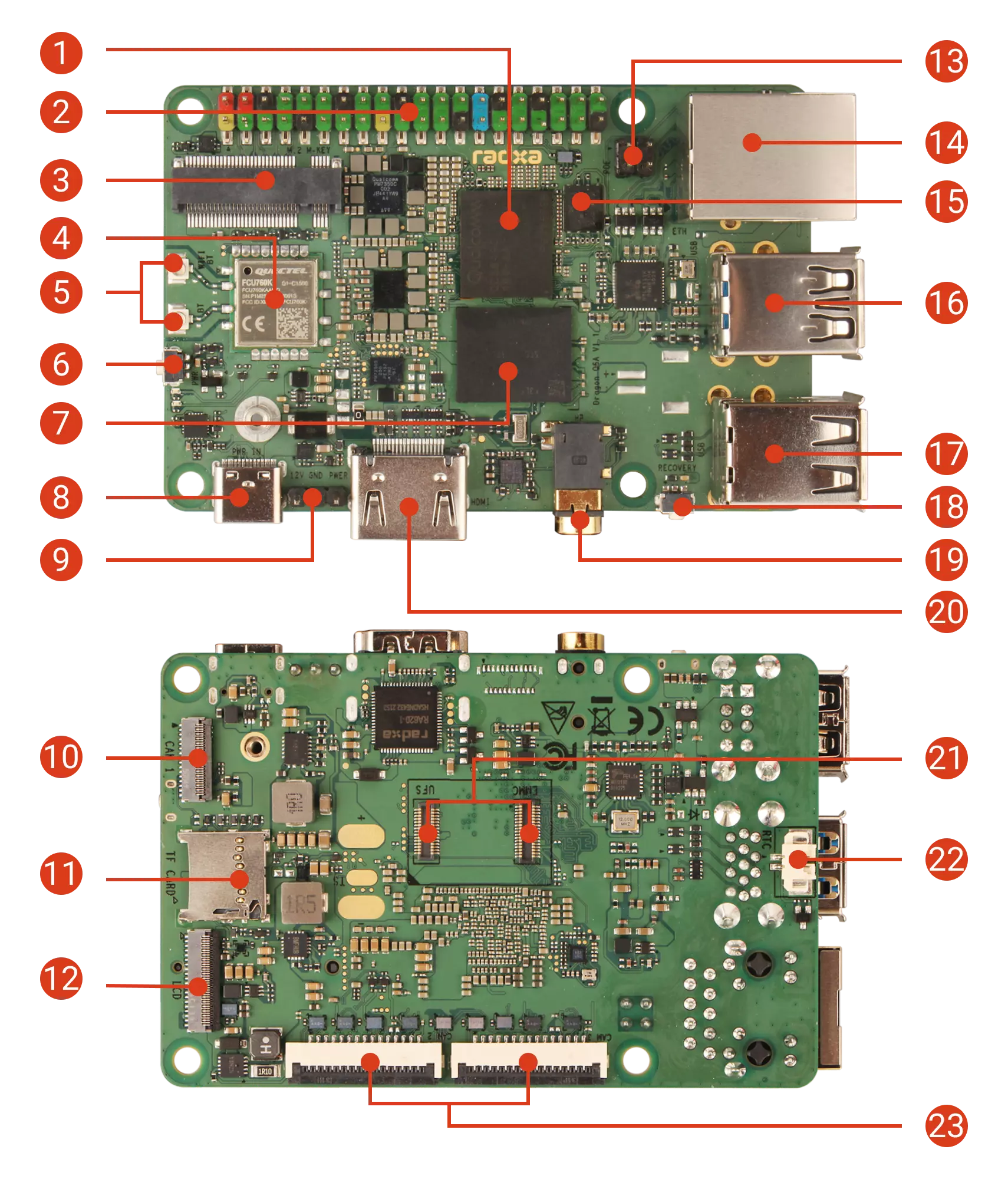
| No. | Description | No. | Description | No. | Description |
|---|---|---|---|---|---|
| 1 | Qualcomm QCS6490 | 2 | 40-Pin GPIO Header | 3 | M.2 M Key slot |
| 4 | WiFi 6 / BT 5.4 | 5 | Antenna connector | 6 | Power button |
| 7 | User LED | 8 | Power LED | 9 | Type-C power input |
| 10 | Power input header | 11 | MIPI CSI (4 Lane) | 12 | microSD card slot |
| 13 | MIPI DSI (4 Lane) | 14 | PoE header | 15 | Gigabit Ethernet |
| 16 | QSPI Nor Flash | 17 | USB 2.0 Type-A port (upper) USB 3.1 OTG Type-A port (lower) | 18 | LPDDR5 memory |
| 19 | 2x USB 2.0 Type-A ports | 20 | EDL button | 21 | Headphone jack |
| 22 | Standard HDMI | 23 | eMMC & UFS combo module connector | 24 | RTC battery connector |
| 25 | 2x MIPI CSI (2 Lane) |
Application Scenarios
Linux Beginners
As a Linux-based single-board computer, it can be used for learning Linux basics, advanced low-level and application-level development.
Robot Development
As the main controller for robot development, it offers excellent performance and a wide range of hardware interfaces, making it easy for users to develop robot applications.
Embedded Development
Provides a rich set of GPIO interfaces, supporting communication protocols such as UART, SPI, and I2C, making it easy for users to drive various hardware devices.
AI Development
Built-in Hexagon DSP + Hexagon Tensor Accelerator, with a combined AI computing power of up to 12 TOPS, accelerating AI development.
System Platform
Based on Qualcomm QCS6490 SoC, supports multiple operating systems:
- Ubuntu Linux
- Qualcomm Linux (Based on Yocto development)
- Android 14