Serial Login
Serial login is a fundamental method for interacting with the ROCK 4D board through a UART (Universal Asynchronous Receiver/Transmitter) interface. It allows you to view system logs and access the command line interface.
When using a USB-to-TTL serial adapter with ROCK 4D, ensure correct pin connections to prevent hardware damage.
Do NOT connect the VCC (red wire) of the USB-to-TTL adapter to avoid potential damage to the board.
Connect the USB-to-TTL adapter to the ROCK 4D's UART0 interface, and the other end to your PC's USB port.
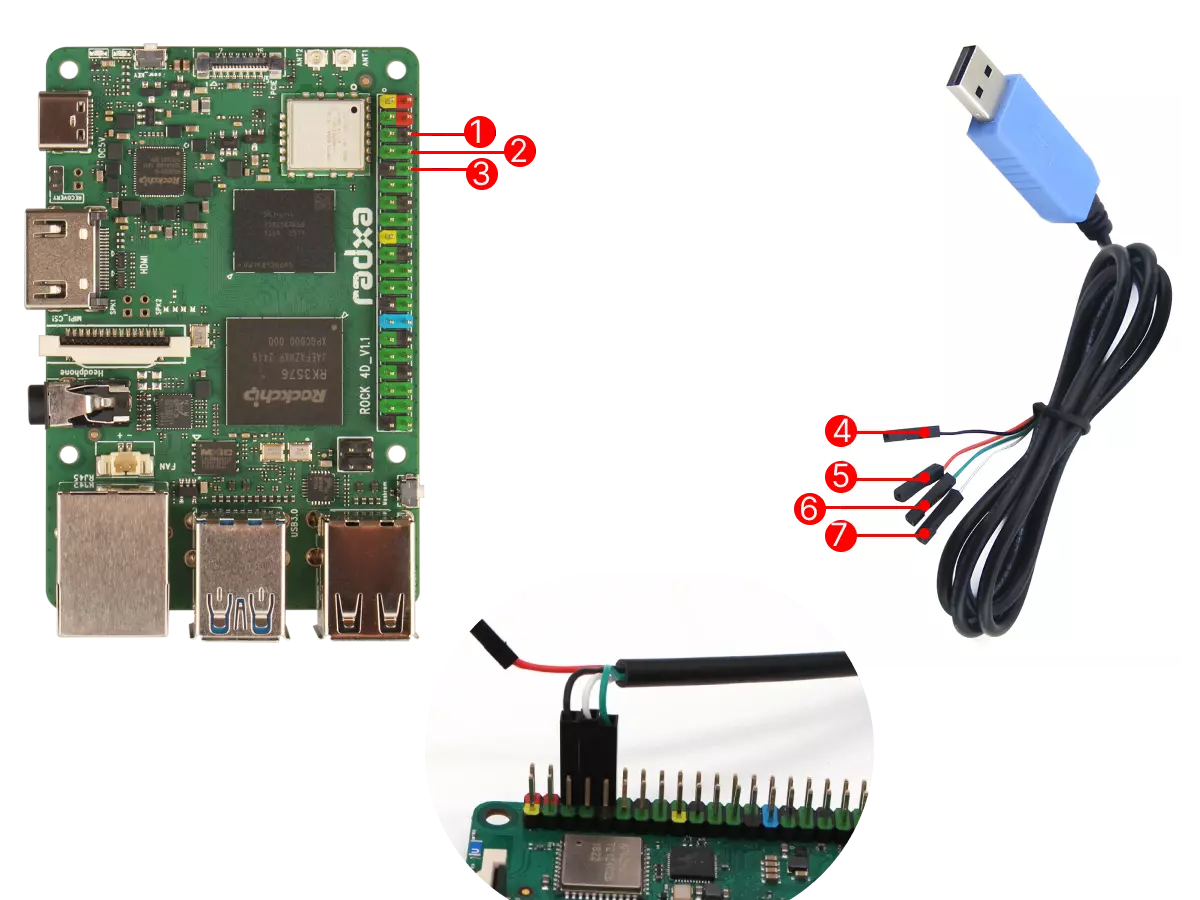
| No. | Pin Function | Connection |
|---|---|---|
| ① | ROCK 4D: GND (Pin6) | Connect to GND pin of USB-TTL |
| ② | ROCK 4D: UART0_TX (Pin8) | Connect to RX pin of USB-TTL |
| ③ | ROCK 4D: UART0_RX (Pin10) | Connect to TX pin of USB-TTL |
| ④ | USB-TTL: GND (Black wire) | Connect to ROCK 4D GND |
| ⑤ | USB-TTL: RX (White wire) | Connect to ROCK 4D UART0_TX |
| ⑥ | USB-TTL: TX (Green wire) | Connect to ROCK 4D UART0_RX |
| ⑦ | USB-TTL: VCC (Red wire) | Do not connect |
Serial Access
Serial Communication Parameters
- Baud Rate: 1500000
- Data Bits: 8
- Stop Bits: 1
- Parity: None
- Flow Control: None
Using Tabby
We recommend using Tabby for serial port login. Tabby is a powerful and user-friendly serial debugging tool that supports multiple protocols including serial port and SSH, and is compatible with mainstream operating systems such as Windows, macOS, and Linux.
Download Tabby
Visit the Tabby official website to download and install the Tabby software.
Install Tabby
Select the appropriate installation package for your operating system and hardware architecture (Windows: tabby-<version>.exe, Linux: tabby-<version>.deb, macOS: tabby-<version>.dmg) to install the Tabby software.
Using Tabby
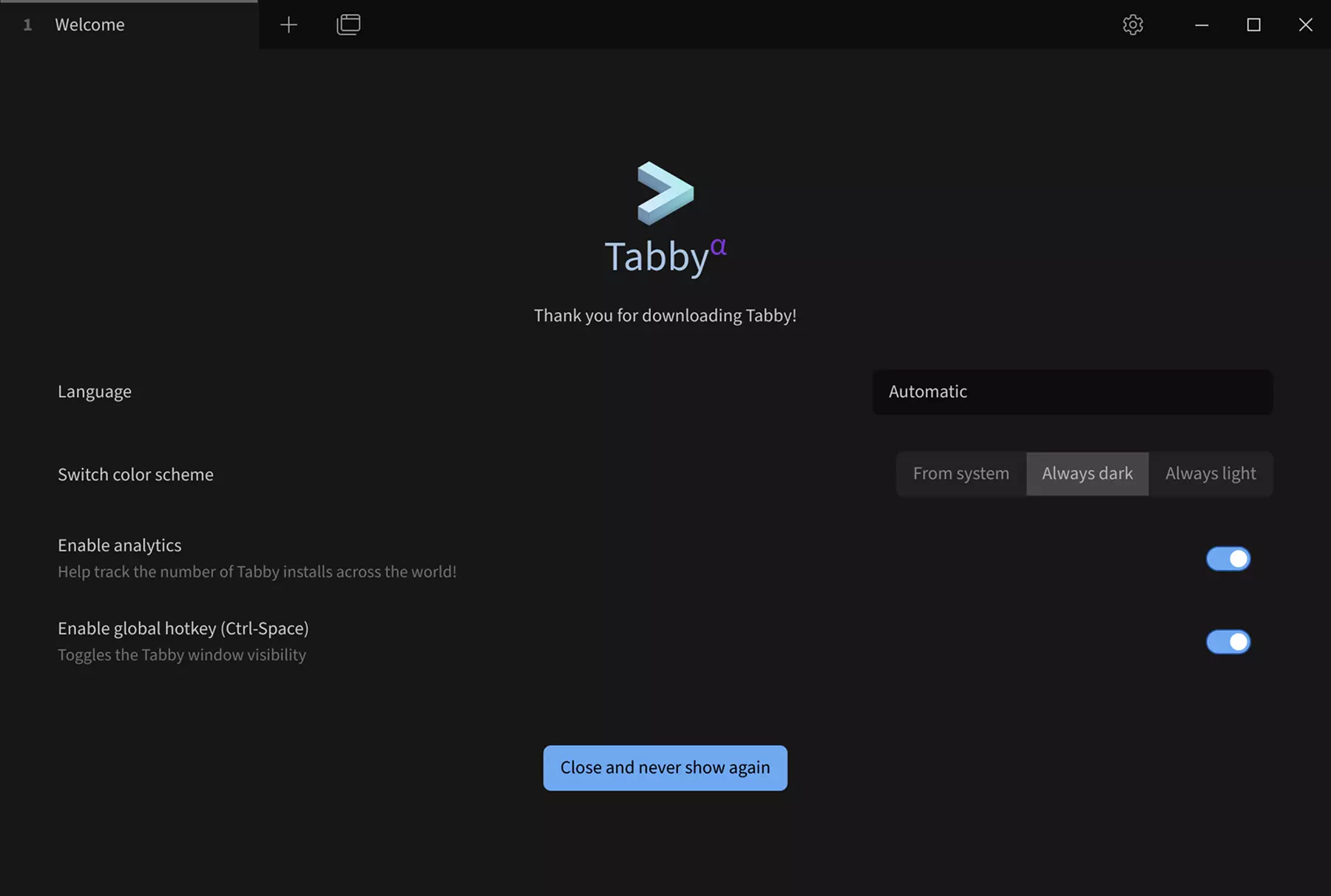
After installation, double-click the Tabby icon to launch the application.
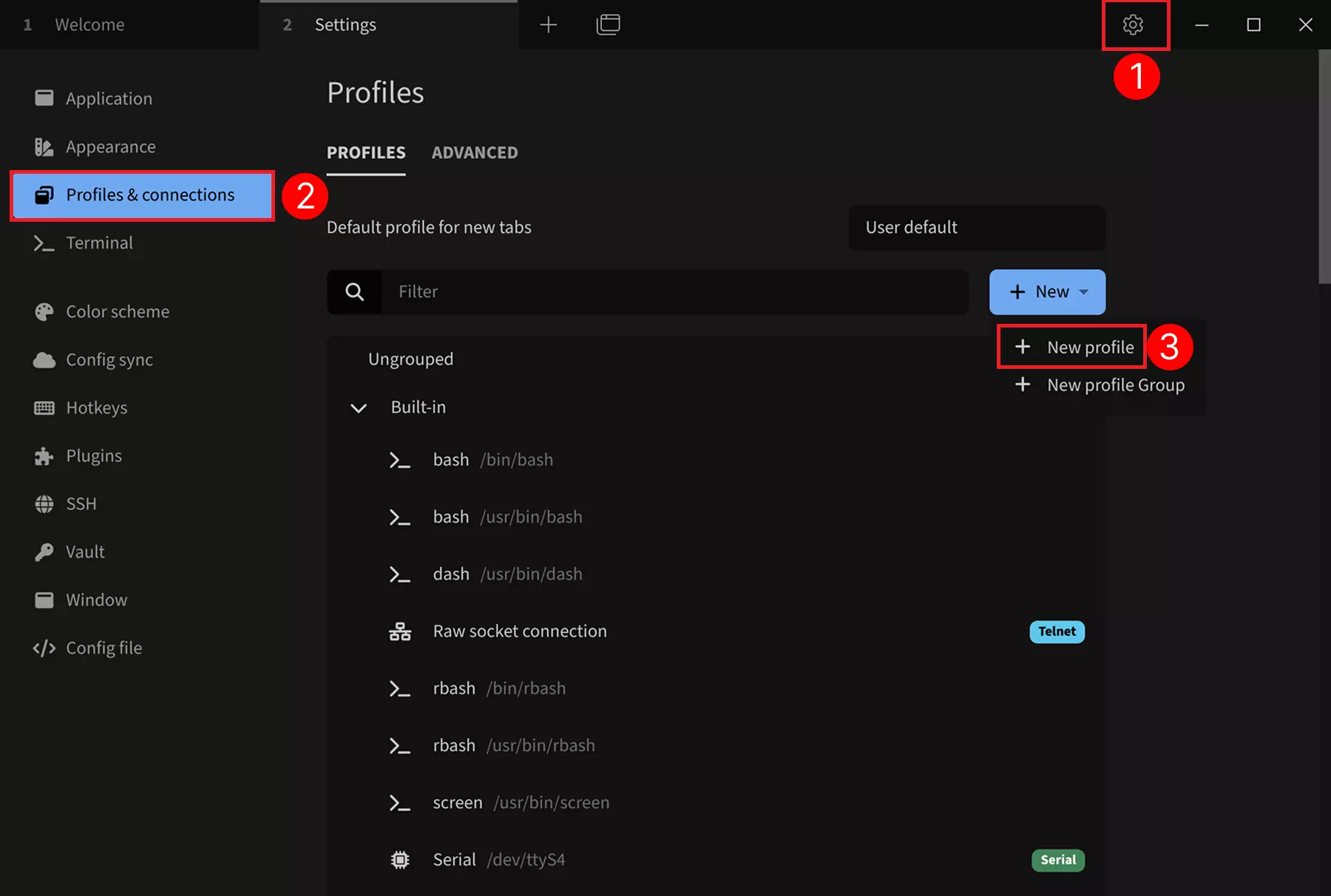
Serial Port Configuration
① --> Settings : Click the settings option
② --> Profiles & connections : Click to configure connection options
③ --> New profile : Click to add a new configuration
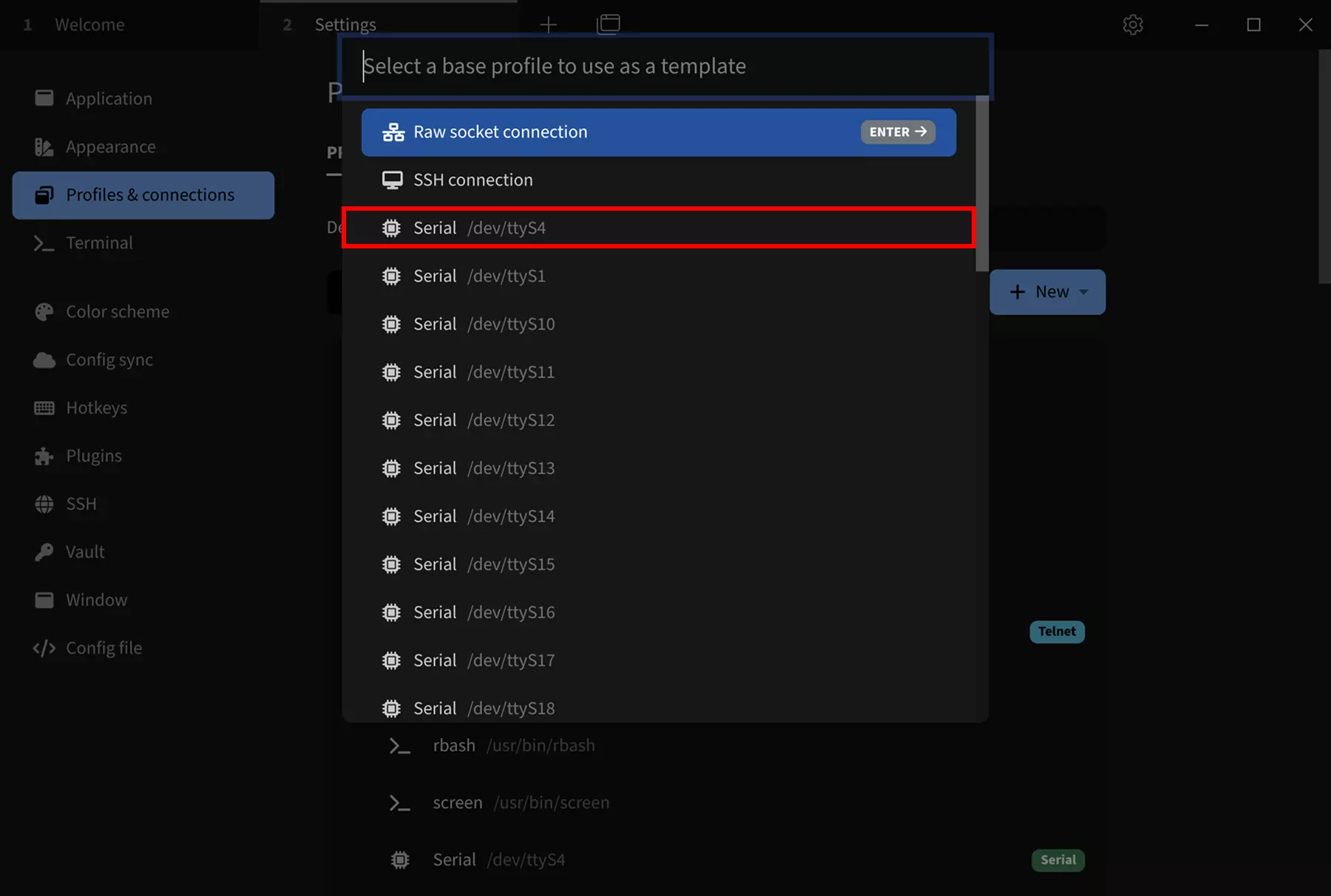
Select Serial Port Template
Choose a base configuration as a template: Select any Serial template. You can modify parameters such as device name, serial port device number, and baud rate in the subsequent configuration interface.
Modify Serial Port Parameters
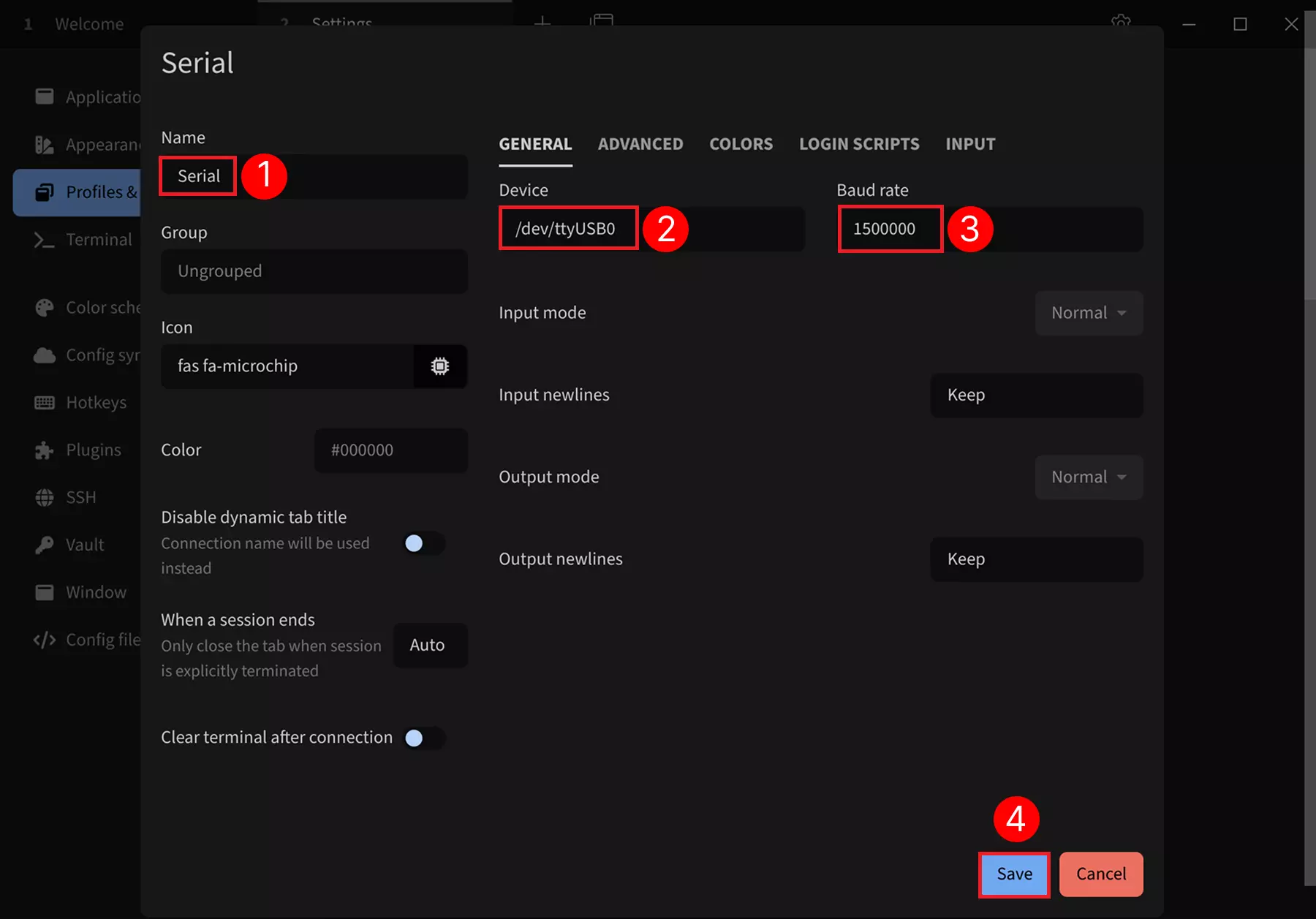
After selecting the Serial template, modify the following parameters:
① --> Name : Set the connection name (recommended to use the product name)
② --> Device : Set the serial port device number (default is /dev/ttyUSB0 if only one serial device is connected to a Linux system)
③ --> Baud rate : Set the baud rate to 1500000
④ --> Save : Save the configuration
For different platforms or when multiple serial devices are connected, you can safely unplug the USB serial cable connected to the board and observe the device number changes to identify the correct device.
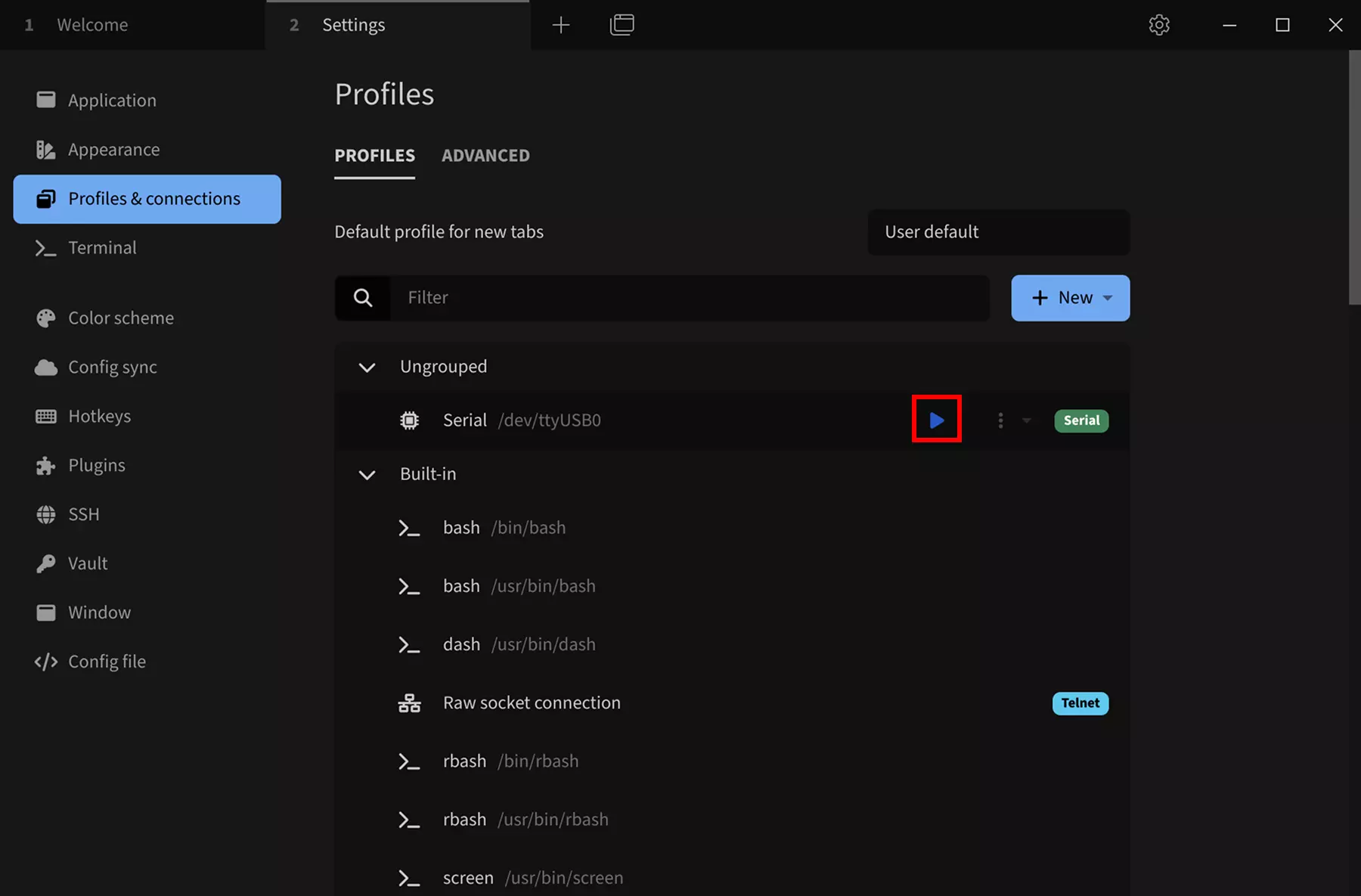
Login via Serial Port
Click the run button to log in to the serial port device.
After a successful connection, press Enter to display the command line interface.
Using the Serial Port
Once successfully logged in via the serial port, you can view system logs and run commands to test system functionality through the serial port.