Frigate NVR for RockChip
Frigate is an NVR project designed specifically for Home Assistant. It can fully leverage local hardware compute and use AI models for real-time object detection, recognition, and classification in surveillance video (for example, distinguishing pedestrians, vehicles, and pets).
Home Assistant is currently the world's most popular open-source smart home control center.
For more details, refer to the official documentation or the official Chinese documentation.
This document shows how to deploy this project on Radxa boards powered by RK3588.
Install the OS
Frigate officially recommends Debian 12 (Bookworm). Follow the installation guide for your device first.
Then you can proceed with the following steps using either the desktop UI or SSH remote access.
VSCode is recommended. You can refer to VS Code Remote SSH Development to connect to the board.
Install Docker
Frigate is deployed as containers. Refer to Install Docker and install Docker on the device before continuing.
Install Frigate
Create the initial directory structure.
mkdir frigate && cd frigate
mkdir storage config && touch docker-compose.yml
Paste the following content into docker-compose.yml.
services:
  frigate:
    container_name: frigate
    restart: unless-stopped
    stop_grace_period: 30s
    image: docker.cnb.cool/frigate-cn/frigate:stable-rk # This image is for RK hardware. Different hardware platforms use different images.
    volumes:
      - ./config:/config
      - ./storage:/media/frigate
      - type: tmpfs
        target: /tmp/cache
        tmpfs:
          size: 1000000000
    security_opt:
      - apparmor=unconfined
      - systempaths=unconfined
    devices:
      - /dev/dri
      - /dev/dma_heap
      - /dev/rga
      - /dev/mpp_service
    ports:
      - '8971:8971'
      - '8555:8554' # RTSP stream. Host port 8555 is used instead of 8554 because port 8554 is needed later for simulated streaming. If you do not need simulation, you can use 8554 directly.
Frigate provides different container variants for different hardware platforms. You can explore other platform deployments if needed.
Now start Frigate with the command below.
Run it in the directory containing docker-compose.yml.
docker compose up -d
After Frigate starts successfully, the frontend service will be available at https://your_device_ip:8971.
Check the board IP address:
hostname -I
Replace your_device_ip with the first IP shown above, then open the URL in your browser.
View the login account and password with:
docker logs frigate
The log may be long. If you cannot find credentials, use Ctrl + F in the VSCode terminal and search for keywords like admin.
Then use the frontend Configuration Editor to adjust settings.
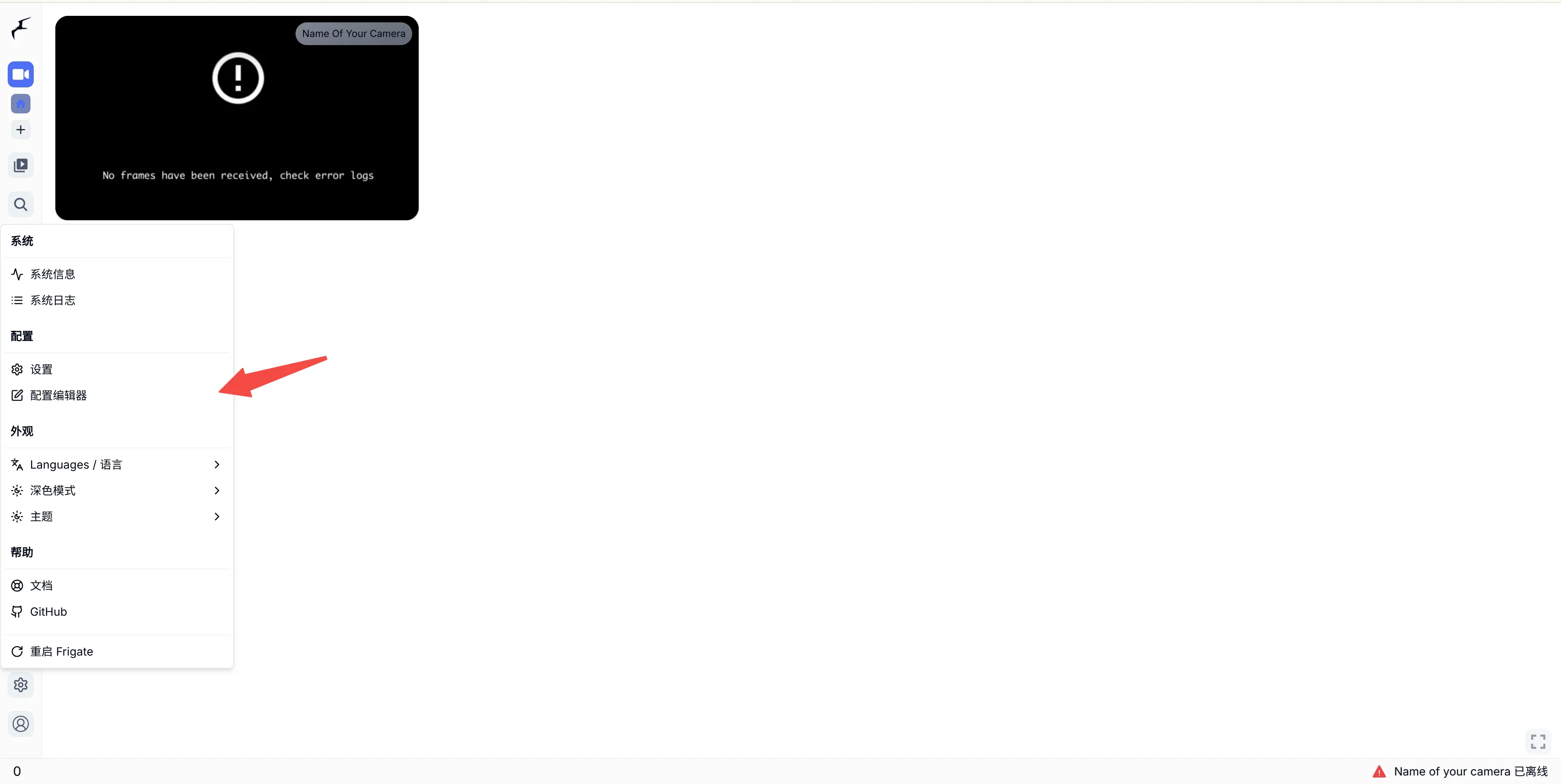
If you have not logged in for more than 24 hours, Frigate may require password login again. It is recommended to update your password from the account menu at the bottom-left.
Simulated streaming
If you do not yet have an IP camera (if you do, use it directly), simulating a stream with FFmpeg + MediaMTX is a good way to validate the setup.
Follow these steps.
MediaMTX
mkdir mediamtx && cd mediamtx
wget https://github.com/bluenviron/mediamtx/releases/download/v1.16.0/mediamtx_v1.16.0_linux_arm64.tar.gz
tar -xvf mediamtx_v1.16.0_linux_arm64.tar.gz
./mediamtx
This starts an RTSP server in the current terminal and waits for incoming stream data.
Open a new terminal, then use FFmpeg to push the stream.
FFmpeg
sudo apt install ffmpeg
Prepare a video file. This guide uses a public video from the Hugging Face dataset KAI-KratosAI/Street-videos.
wget https://huggingface.co/datasets/KAI-KratosAI/Street-videos/resolve/0d33ede195de1fc061723d5dfa4623b30162af66/041896fb-20da-4625-9455-195172efc4d5.mp4_041896fb-20da-4625-9455-195172efc4d5.mp4#t=0.001
mv 041896fb-20da-4625-9455-195172efc4d5.mp4_041896fb-20da-4625-9455-195172efc4d5.mp4 test.mp4
ffmpeg -re -stream_loop -1 -i test.mp4 -c copy -f rtsp rtsp://localhost:8554/mystream
Parameter explanation:
-re: Read at native speed. Without this, FFmpeg may push data too fast and the stream appears as fast-forward.-stream_loop -1: Loop video indefinitely, useful for Frigate testing.-i test.mp4: Input video file.-c copy: Copy codecs without re-encoding, minimizing CPU usage.-f rtsp: Output RTSP format.rtsp://localhost:8554/mystream: Stream URL.mystreamis the stream ID.
Then modify the configuration in the frontend UI:
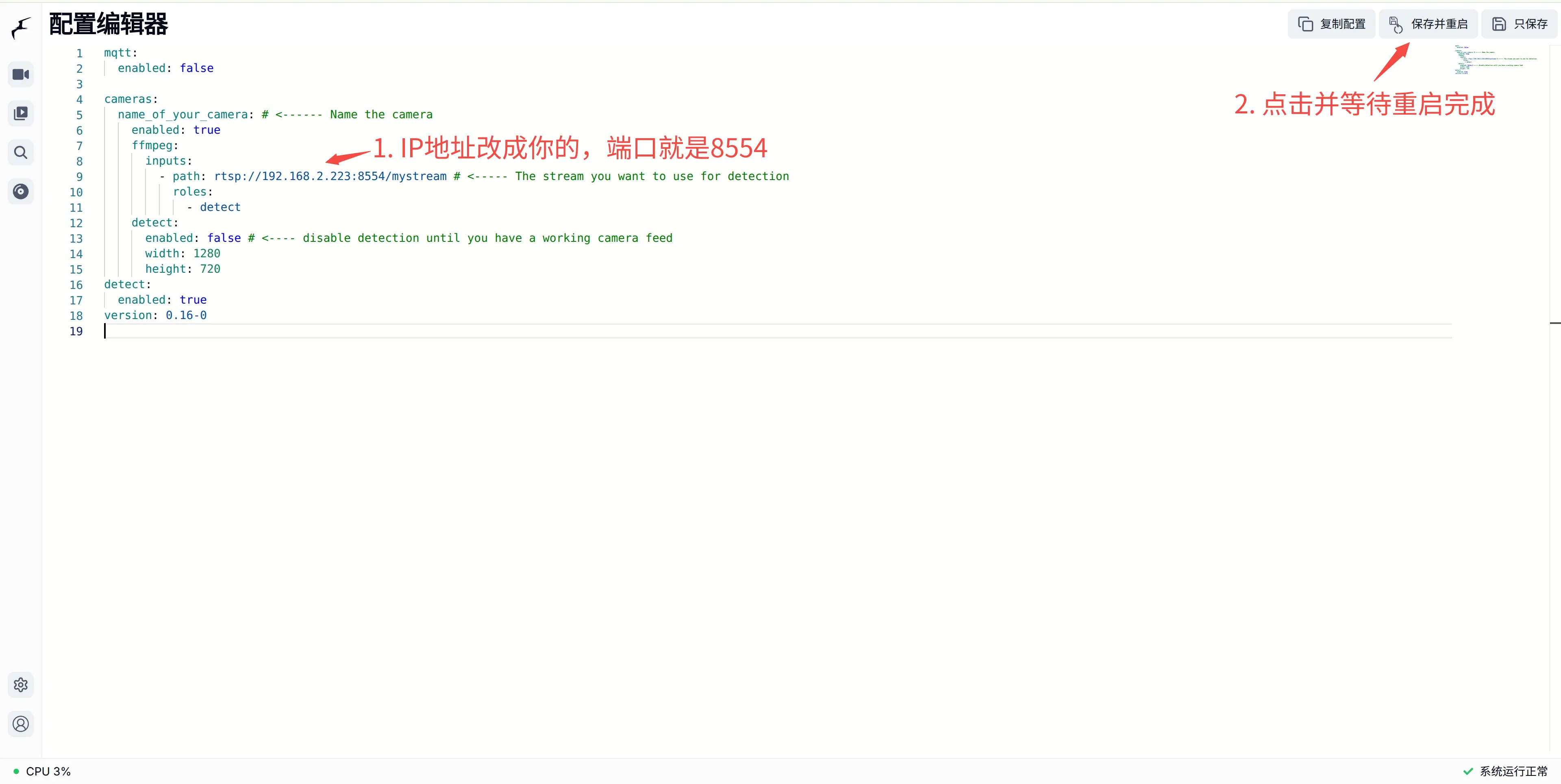
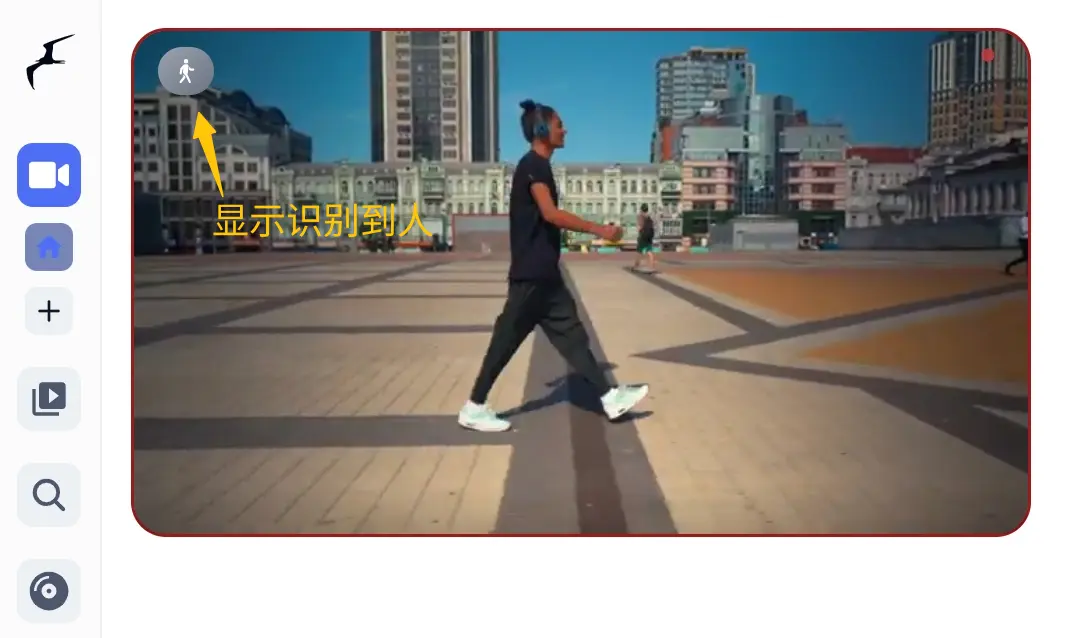
Then you should be able to see the live camera feed on the homepage.
Enable AI model
First ensure you are running a Linux distribution with Rockchip BSP kernel 5.10 or 6.1 and required drivers (especially rkvdec2 and rknpu):
uname -r
# 5.10.x-rockchip or 6.1.x-rockchip; the -rockchip suffix is important
ls /dev/dri
# by-path  card0  card1  renderD128  renderD129; renderD128 (VPU) and renderD129 (NPU) should be present
sudo cat /sys/kernel/debug/rknpu/version
# RKNPU driver: v0.9.2 or later
Then update the configuration in the frontend UI:
mqtt:
  enabled: false

detectors:
  rknn_0:
    type: rknn
    num_cores: 3

model: # required
  # Model name (auto-downloaded) or path to a custom .rknn model file
  # Optional values:
  # - frigate-fp16-yolov9-t
  # - frigate-fp16-yolov9-s
  # - frigate-fp16-yolov9-m
  # - frigate-fp16-yolov9-c
  # - frigate-fp16-yolov9-e
  # Or a full in-container path to your yolo_model.rknn file
  # Refer to official docs for more model configuration details
  path: frigate-fp16-yolov9-t
  model_type: yolo-generic
  width: 320
  height: 320
  input_tensor: nhwc
  labelmap_path: /labelmap/coco-80.txt

# ffmpeg:
#   hwaccel_args: preset-rkmpp # <----- these two lines are optimization settings from official docs, but may conflict with FFmpeg push streaming, so they are disabled here

go2rtc:
  streams:
    camera:
      - rtsp://your_device_ip:8554/mystream # <----- replace with your device IP
      - 'ffmpeg:back#video=h264#hardware'

cameras:
  name_of_your_camera: # <------ Name the camera
    enabled: true
    ffmpeg:
      inputs:
        - path: rtsp://your_device_ip:8554/mystream # <----- The stream you want to use for detection
          roles:
            - detect
    detect:
      enabled: true # <---- disable detection until you have a working camera feed
      width: 848
      height: 464

detect:
  enabled: true
version: 0.16-0
Refer to official documentation for additional model configuration options.
Restart Frigate after the modification.
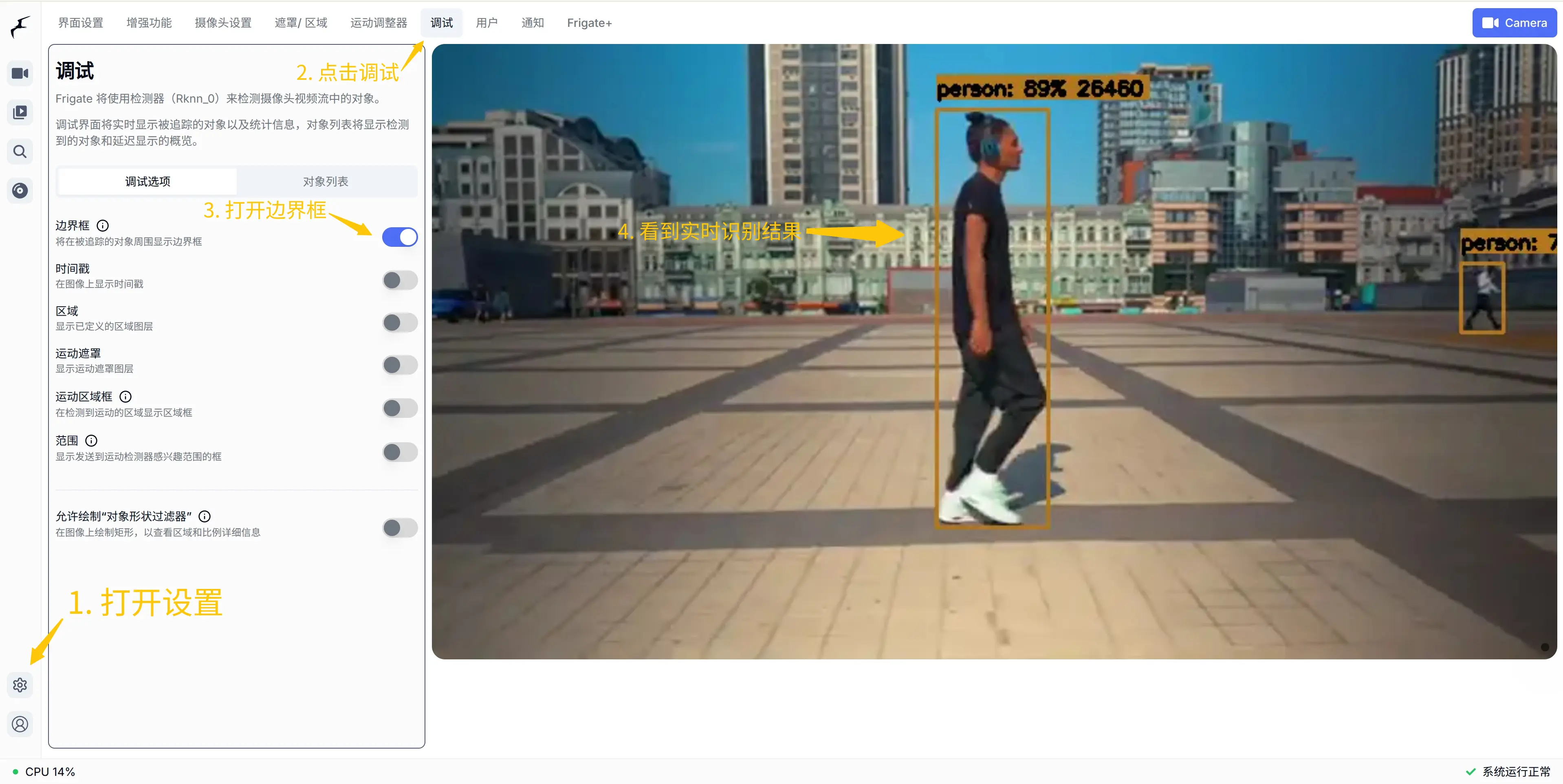
You have now successfully deployed Frigate on RK3588.