Buildroot Build
Environment Preparation
Prepare an Ubuntu 20.04/22.04 x86_64 host machine.
You can also work inside a virtual machine:
- ubuntu-22.04.5-live-server-amd64 VM with at least 120G of free disk space.
Install Build Dependencies
sudo apt update
sudo apt install python2 git rsync gcc g++ make device-tree-compiler bc flex bison lz4 libssl-dev libgmp-dev libmpc-dev expect expect-dev file unzip bzip2 fakeroot bsdmainutils
sudo ln -s /bin/python2 /bin/python
Download the Rockchip Reference SDK
Extract the SDK
On the Ubuntu host, run the following commands to unpack the SDK:
tar -xvzf rk3308_linux5.10_rkr8_sdk.repo.tar.gz
.repo/repo/repo sync -l
Add ROCK Pi S0 Board Support
Use the Radxa-maintained rockchip repository:
cd device/rockchip
git remote add radxa https://github.com/radxa/device-rockchip.git
git fetch radxa
git checkout -b rk3308-linux-5.10 remotes/radxa/rk3308-linux-5.10
Use the Radxa-maintained rkbin repository:
cd rkbin
git remote add radxa https://github.com/radxa/rkbin.git
git fetch radxa
git checkout -b develop-v2025.04 remotes/radxa/develop-v2025.04
Use the Radxa-maintained kernel repository:
cd kernel
git remote add radxa https://github.com/radxa/kernel.git
git fetch radxa
git checkout -b linux-5.10-gen-rkr8-buildroot remotes/radxa/linux-5.10-gen-rkr8-buildroot
Build the SDK
From the root of the SDK run:
./build.sh
Then choose the rockchip_rk3308_rock_s0_defconfig configuration file.
After the build finishes, images are produced under the rockdev/ directory. The system image file is update.img.
Flash the Image
Flash the Image to eMMC
On a Linux or macOS host, use upgrade_tool over the 4-pin USB2.0 OTG port to flash the update.img system image into eMMC:
upgrade_tool uf update.img
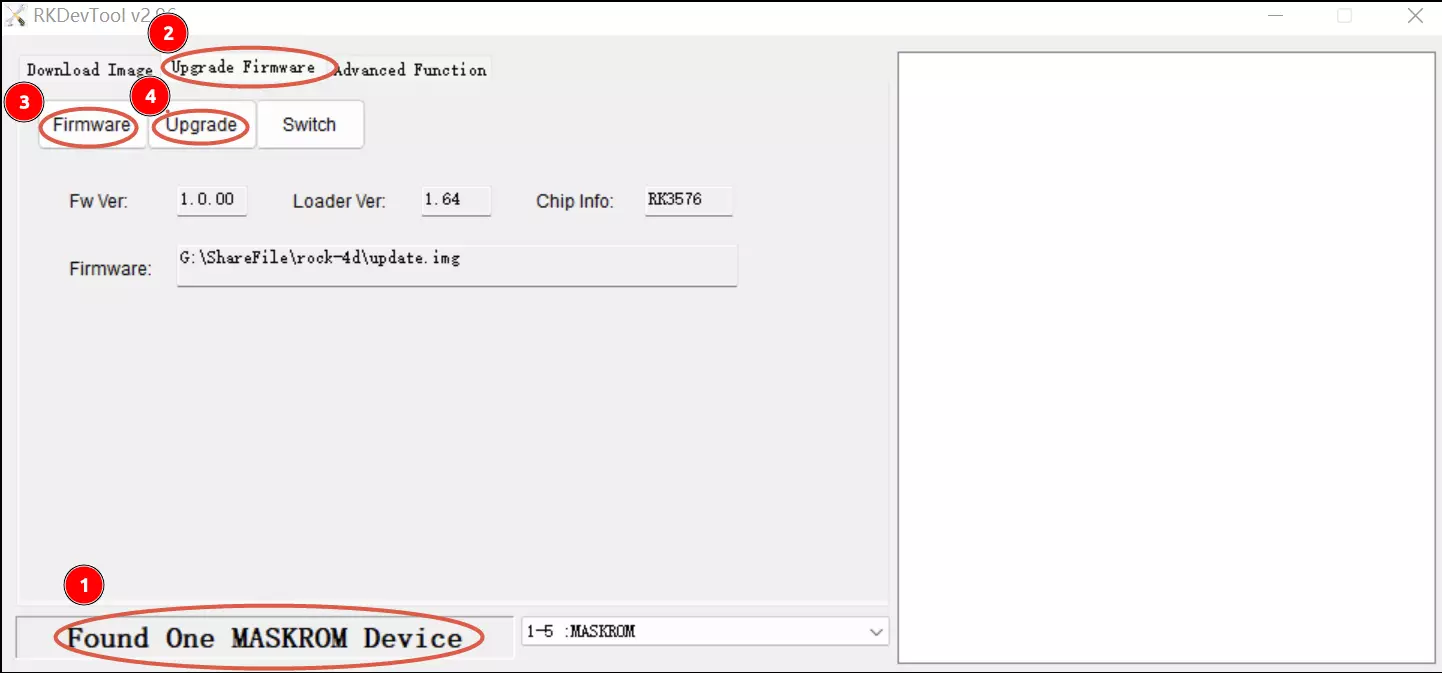
On Windows, use RKDevTool via the Type-A flashing port to write update.img into eMMC:
- ①: Put the device into Maskrom mode.
- ②: Choose the
Upgrade Firmwareoption. - ③: Click
Firmwareand select the generatedupdate.img. - ④: Click
Upgradeto start flashing the system image.
Flash the Image to a microSD Card
Use SDDiskTool to write the generated image to a microSD card.
SDDiskTool is Rockchip's official SD card flashing tool.
-
Download SDDiskTool
-
SDDiskTool currently only has a Windows version, so please use it on a Windows computer.
-
Download link:SDDiskTool_en_v1.74.zip
-
-
Flash SD card
-
We need to flash the corresponding complete image in RK format.
-
Complete image in RK format refers to The
update.imgimage compiled using a series of Linux SDKs released by Rockchip based on Buildroot -
Open the executable file
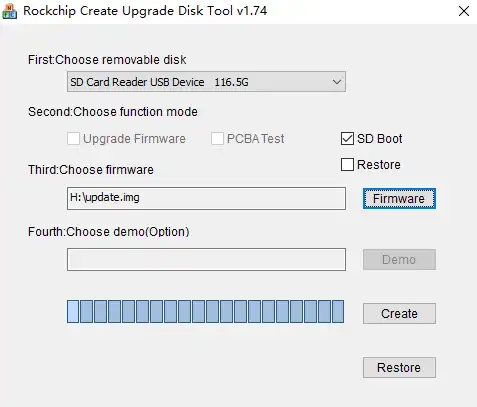
SD_Firmware_Tool.exeof SDDiskTool and insert the SD card.warningWhen multiple storage devices are connected, please ensure you select the correct SD card to flash, otherwise other storage devices may be overwritten.
-
Select the SD card to flash from the removable disk devices, choose SD Boot as the function mode, ensure that the firmware upgrade is a complete image in RK format, and finally click Create to flash the image.
-
Please be patient during the flashing process. The image contains many partitions, and if the image is large, the flashing time will be longer.
-
If you encounter problems clearing the MBR while burning, you need to change the SD card disk label type from dos to gpt.
- Windows
- Linux
-
Delete all partitions and convert to gpt using command prompt under windows
-
Press Win + X and select Windows Terminal (Administrator) or Command Prompt (Administrator).
-
Enter the following command and press Enter:
-
diskpart
- Then, enter the following command to list all disks:
list disk
- Locate your SD card (assuming it is disk 3) and enter:
select disk 3
-
(If your SD card has a different disk number, change 3 to the correct number accordingly.)
-
Clear all partitions on the disk:
clean
-
(This deletes all partitions and data on the SD card.)
-
Converts a disk to GPT format:
convert gpt
- Type
exitto exit the diskpart utility.
-
Use the fdisk command to change the label format to gpt on Linux.
- Find your SD card (assuming it's /dev/sdb) and enter:
sudo fdisk /dev/sdb
-
Type
pand the label format and partition of the current disk will be displayed. -
Then type
gto convert the disk to gpt format -
Then just type
wqto save and exit.