Install System to UFS Module from microSD Card or Onboard eMMC
This guide explains how to install the system to UFS using the dd command when the system can boot normally from a microSD card or onboard eMMC .
Installing the system will format the UFS module or onboard UFS. Please back up any important data in advance!
Prerequisites
To use the dd command to install the system to UFS, you need to meet the following conditions:
- The system can boot normally from a microSD card or onboard eMMC
- UFS is installed on the board or the board has onboard UFS
Hardware Connection
- UFS Module
- Onboard UFS
UFS Module Installation Steps:
- Observe the notch direction on the UFS module and the notch marking on the board's UFS module interface to determine the correct installation orientation.
- Place the UFS module above the board's UFS module interface, ensuring the UFS module interface is properly aligned with the board's UFS module interface.
- Gently press one end of the UFS module until you hear a "click" sound, indicating successful installation. Then press the other end in the same way to ensure the UFS module is properly installed.
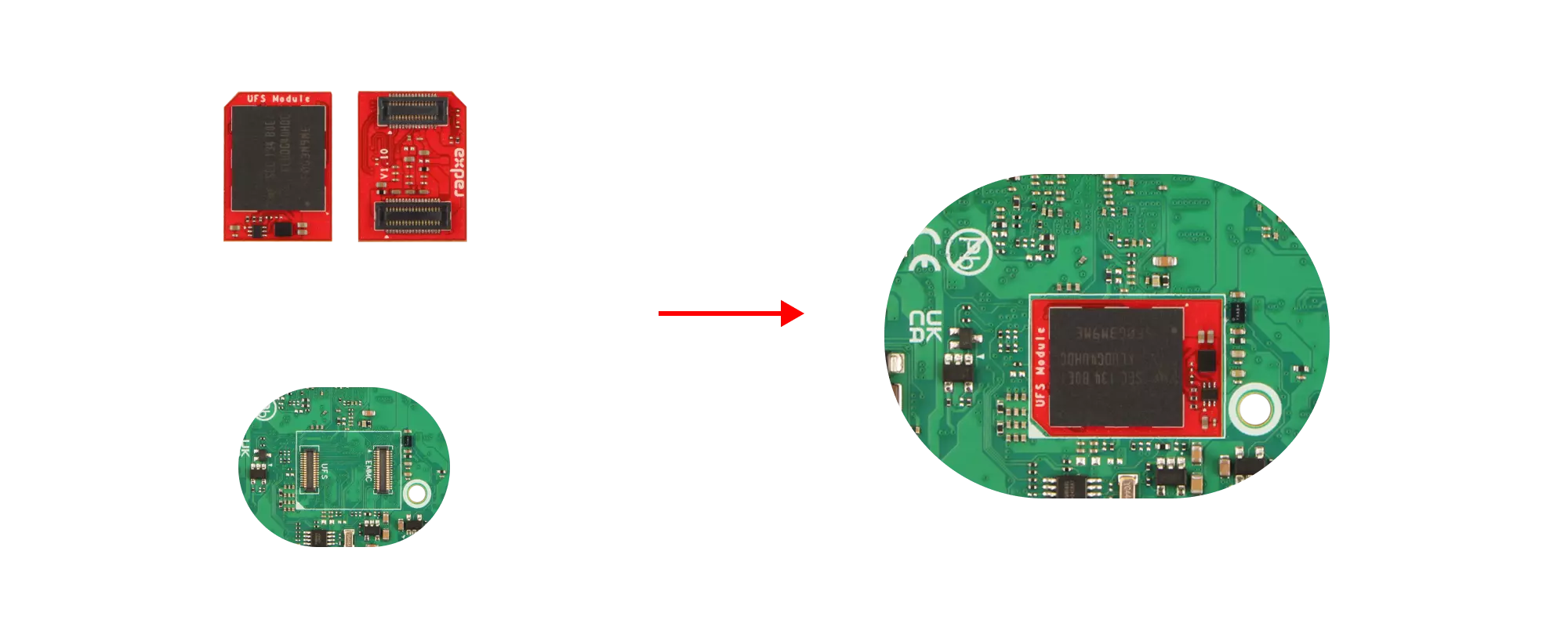
If your board has onboard UFS, no installation is required.
System Installation
Download System Image
Access the Resource Download page from your device and download the latest system image to the device.
The downloaded system image is a compressed file and needs to be extracted before use!
You can use the wget command to download the system image file to your device.
sudo apt update
sudo apt install wget -y
wget <download_url>
Where <download_url> is the download URL of the system image file. You can copy the image download URL from the Resource Download page to replace it.
Download example: wget https://github.com/radxa-build/radxa-rk3576/releases/download/rsdk-r6/radxa-rk3576_bookworm_kde_r6.output_4096.img.xz
Extract System Image
Our system images are generally in *.img.xz format and need to be extracted before use.
sudo apt install xz-utils -y
unxz <path_to_image_unxz>
Where <path_to_image_unxz> is the path to the system image file, which needs to be replaced with the actual system image file path.
Extraction example:
unxz radxa-rk3576_bookworm_kde_r6.output_4096.img
Determine Device Path
You can use the lsblk command to check the device path and determine it based on the disk capacity.
Note: If the disk capacities are similar, you can safely remove and reinsert the UFS module to observe which device path appears and disappears, thus determining the correct device path.
lsblk
If the system recognizes the UFS device, it will typically be identified as a /dev/sd* device.
Terminal output example:
NAME        MAJ:MIN RM   SIZE RO TYPE MOUNTPOINTS
···
sda           8:0    0 119.2G  0 disk
└─sda1        8:1    0 119.2G  0 part
···
Install System Image
Use the dd command to install the system image to the UFS.
sudo dd if=<path_to_image> of=<device_target> bs=4M status=progress
Write example:
sudo dd if=radxa-rk3576_bookworm_kde_r6.output_4096.img of=/dev/sda bs=4M status=progress
Parameter description:
-
<path_to_image>: The path to the system image file, which needs to be replaced with the actual system image file path. -
<device_target>: The device path of the UFS module, which needs to be replaced with the actual UFS module's device path. -
bs=4M: Block size for writing. -
status=progress: Display write progress.
Verify Write Result
After the system installation is complete, you can use the lsblk command to check if the UFS partition table has been created correctly.
lsblk
Terminal output example:
NAME        MAJ:MIN RM   SIZE RO TYPE MOUNTPOINTS
···
sda           8:0    0 119.2G  0 disk
├─sda1        8:1    0   128M  0 part
├─sda2        8:2    0   2.3G  0 part
└─sda3        8:3    0   6.4G  0 part
···
Note: To boot from UFS, you need to short the UFS BOOT pins using a jumper cap or DuPont wire (after shorting, the system cannot boot from eMMC). For the connector location, refer to the Other Interfaces document.