rsetup
Rsetup User Guide
Introduction
rsetup is a system configuration tool for Radxa OS. It provides a friendly TUI (text user interface) for managing system settings, hardware configuration, and network connectivity.
Launch rsetup
To start rsetup, run:
rsetup
Or launch it from the system menu.
rsetup requires administrator privileges. Please make sure you have sudo permission.
If you start it as a normal user, the system may prompt you to elevate privileges using pkexec or sudo.
The options listed below are for reference only and are subject to the actual program output.
┌──────────────────────────────────┤ RSETUP ├──────────────────────────────────┐
│ Please select an option below:                                               │
│                                                                              │
│                             System Maintenance                               │
│                             Hardware                                         │
│                             Overlays                                         │
│                             Connectivity                                     │
│                             User Settings                                    │
│                             Localization                                     │
│                             Common Tasks                                     │
│                             About                                            │
│                                                                              │
│                     <Ok>                         <Cancel>                    │
│                                                                              │
└──────────────────────────────────────────────────────────────────────────────┘
UI navigation
Basic keys
- Up/Down: Move between menu items
- Tab: Switch between the menu area and the command area
- Left/Right: Switch between
<Ok>and<Cancel> - Enter: Confirm/execute
- Space: Select options (
[ ]for multi-select,( )for single-select) - Esc: Go back
Pressing Enter does not toggle options. It executes <Ok> directly.
To toggle an option, use Space.
System Maintenance
This menu contains the following options:
┌──────────────────────────────────┤ RSETUP ├──────────────────────────────────┐
│ System Maintenance                                                           │
│                                                                              │
│                         System Update                                        │
│                         Change APT Sources                                   │
│                         Change default boot target                           │
│                         Update Bootloader                                    │
│                         Update SPI Bootloader                                │
│                         Update eMMC Boot partition                           │
│                         Sleep / Hibernate Control                            │
│                                                                              │
│                     <Ok>                         <Cancel>                    │
│                                                                              │
└──────────────────────────────────────────────────────────────────────────────┘
Change APT Sources
This option lets you switch Radxa and Debian/Ubuntu mirrors to improve download speed.
┌──────────────────────────────────┤ RSETUP ├──────────────────────────────────┐
│ APT Sources                                                                  │
│                                                                              │
│                         Select Radxa mirror                                  │
│                         Select Debian/Ubuntu mirror                          │
│                         Restore official sources                             │
│                                                                              │
│                     <Ok>                         <Cancel>                    │
└──────────────────────────────────────────────────────────────────────────────┘
Supported mirrors include:
-
Radxa mirrors:
- https://mirrors.aghost.cn/radxa-deb
- https://mirrors.cqu.edu.cn/radxa-deb (Chongqing University)
- https://mirrors.lzu.edu.cn/radxa-deb (Lanzhou University)
- https://mirrors.hust.edu.cn/radxa-deb (HUST)
- https://mirrors.sdu.edu.cn/radxa-deb (Shandong University)
- https://mirror.nju.edu.cn/radxa-deb (Nanjing University)
- https://mirror.nyist.edu.cn/radxa-deb (NYIST)
-
Debian/Ubuntu mirrors:
- https://mirrors.ustc.edu.cn (USTC)
- https://mirrors.tuna.tsinghua.edu.cn (Tsinghua University)
- https://mirrors.cqu.edu.cn (Chongqing University)
- https://mirrors.lzu.edu.cn (Lanzhou University)
- https://mirrors.hust.edu.cn (HUST)
- https://mirrors.sdu.edu.cn (Shandong University)
- https://mirror.nju.edu.cn (Nanjing University)
- https://mirror.nyist.edu.cn (NYIST)
Steps:
- Choose
Select Radxa mirrororSelect Debian/Ubuntu mirror - Select a mirror from the list
- Confirm to update sources
- To revert, choose
Restore official sources
System Update
Do not use apt-get upgrade to update the system. It may result in an incomplete upgrade, missing functionality, or even a failure to boot.
Use rsetup for system updates.
This option updates installed packages to the latest release.
Since Radxa OS provides packages that may conflict with upstream Debian, updating via rsetup is recommended.
Change default boot target
Set the default boot target:
multi-user.target: CLIgraphical.target: Desktop
Update Bootloader
Updates the bootloader on the disk where the root filesystem resides.
Update SPI Bootloader
Updates the bootloader on SPI flash.
Update eMMC Boot partition
Updates the bootloader on the eMMC Boot partition.
Sleep / Hibernate Control
- Enable Sleep / Hibernate: Enable suspend/hibernate
- Disable Sleep / Hibernate: Disable suspend/hibernate
Reboot is recommended after changes.
Hardware
Some peripherals can be configured here:
┌──────────────────────────────────┤ RSETUP ├──────────────────────────────────┐
│ Manage on-board hardware                                                     │
│                                                                              │
│                      Video capture devices                                   │
│                      GPIO LEDs                                               │
│                      RGB LEDs                                                │
│                      Thermal governor                                        │
│                      Configure DSI display mirroring                         │
│                      40-pin GPIO                                             │
│                      USB OTG services                                        │
│                                                                              │
│                     <Ok>                         <Cancel>                    │
│                                                                              │
└──────────────────────────────────────────────────────────────────────────────┘
Video capture devices
If a video device is connected, this option can help you test it.
┌──────────────────────────────────┤ RSETUP ├──────────────────────────────────┐
│ Select video capture device:                                                │
│                                                                              │
│                         video0                                               │
│                         video1                                               │
│                         video2                                               │
│                                                                              │
│                     <Ok>                         <Cancel>                    │
└──────────────────────────────────────────────────────────────────────────────┘
GPIO LEDs
You can change the status of the power LED and user LED.
LED Setup
LED Setup
Some products will have user-controllable LEDs on-board. They can be managed via rsetup:
┌──────────────────────────────────┤ RSETUP ├──────────────────────────────────┐
| Below are the available LEDs and their triggers.                             |
| Select any to update their trigger.                                          |
|                                                                              |
|    [ ] user-led1 [default-on]                                                |
|    [ ] user-led2 [heartbeat]                                                 |
|                                                                              |
|                     <Ok>                         <Cancel>                    |
|                                                                              |
└──────────────────────────────────────────────────────────────────────────────┘
The content inside '[ ]' at the end is the current LED trigger, which can be roughly understood as the LED status.
On Radxa products, the power LED usually has default-on trigger, while the status LED usually has heartbeat trigger.
Change LED light status
The following steps help us to change light status:
- Use the
upordownkey to move the highlighted selection to which LED you want to edit the status; - Use the
Spacebar to confirm your choose, a*would appeare on the[ ]at the start.
┌──────────────────────────────────┤ RSETUP ├──────────────────────────────────┐
| Below are the available LEDs and their triggers.                             |
| Select any to update their trigger.                                          |
|                                                                              |
|    [*] user-led1 [default-on]                                                |
|    [ ] user-led2 [heartbeat]                                                 |
|                                                                              |
|                     <Ok>                         <Cancel>                    |
|                                                                              |
└──────────────────────────────────────────────────────────────────────────────┘
- Press
Enterto go to the trigger selection menu:
┌──────────────────────────────────┤ RSETUP ├──────────────────────────────────┐
│ Please select the new trigger:                                               │
│                                                                              │
│    ( ) none                                                                  │
│    ( ) rfkill-any                                                            │
│    ( ) rfkill-none                                                       ▒   │
│    ( ) kbd-scrolllock                                                    ▒   │
│    ( ) kbd-numlock                                                       ▒   │
│    ( ) kbd-capslock                                                      ▒   │
│    ( ) kbd-kanalock                                                      ▒   │
│    ( ) kbd-shiftlock                                                     ▒   │
│    ( ) kbd-altgrlock                                                     ▒   │
│    ( ) kbd-ctrllock                                                      ▒   │
│    ( ) kbd-altlock                                                       ▒   │
│    ( ) kbd-shiftllock                                                    ▒   │
│    ( ) kbd-shiftrlock                                                    ▒   │
│    ( ) kbd-ctrlllock                                                     ▒   │
│    ( ) kbd-ctrlrlock                                                     ▒   │
│    ( ) disk-activity                                                         │
│             (and more)                                                       │
│                                                                              │
│                     <Ok>                         <Cancel>                    │
│                                                                              │
└──────────────────────────────────────────────────────────────────────────────┘
- Use the
upanddownarrow keys to select which you like and pressSpaceto confirm, a*would appeare on the( )like step 2. - Press
Enterto save your choose and apply it. - Your LED status would change after step 5 at once.
RGB LEDs
Control onboard RGB LEDs.
Thermal governor
Adjust thermal policy and fan behavior.
Generally, choose power_allocator for DC fan/fanless, and step_wise for PWM fan.
Note: If you connect a fan directly to GPIO 5V and GND, it will always run and cannot be controlled.
Configure DSI display mirroring
If the DSI display has issues when HDMI and DSI are used together, enabling this option may help.
USB OTG services
Configure gadget functions for the OTG port:
# `*.*` is the corresponding USB controller

radxa-adbd@*.*  # ADB device
radxa-ecm@*.*   # ECM device (not recommended)
radxa-ncm@*.*   # NCM device (recommended)
40-pin GPIO
Configure the 40-pin GPIO header.
Overlays
This option is used to configure device tree overlays.
Device Tree Configuration
Device tree settings
Device Tree Overlays make it possible to support multiple hardware configurations with a single kernel, without explicitly loading or masking kernel modules.
You can use rsetup to manage overlays.
How to Enable an Overlay
In the screen of rsetup, use the arrow keys to move up, down, left, right, and select.
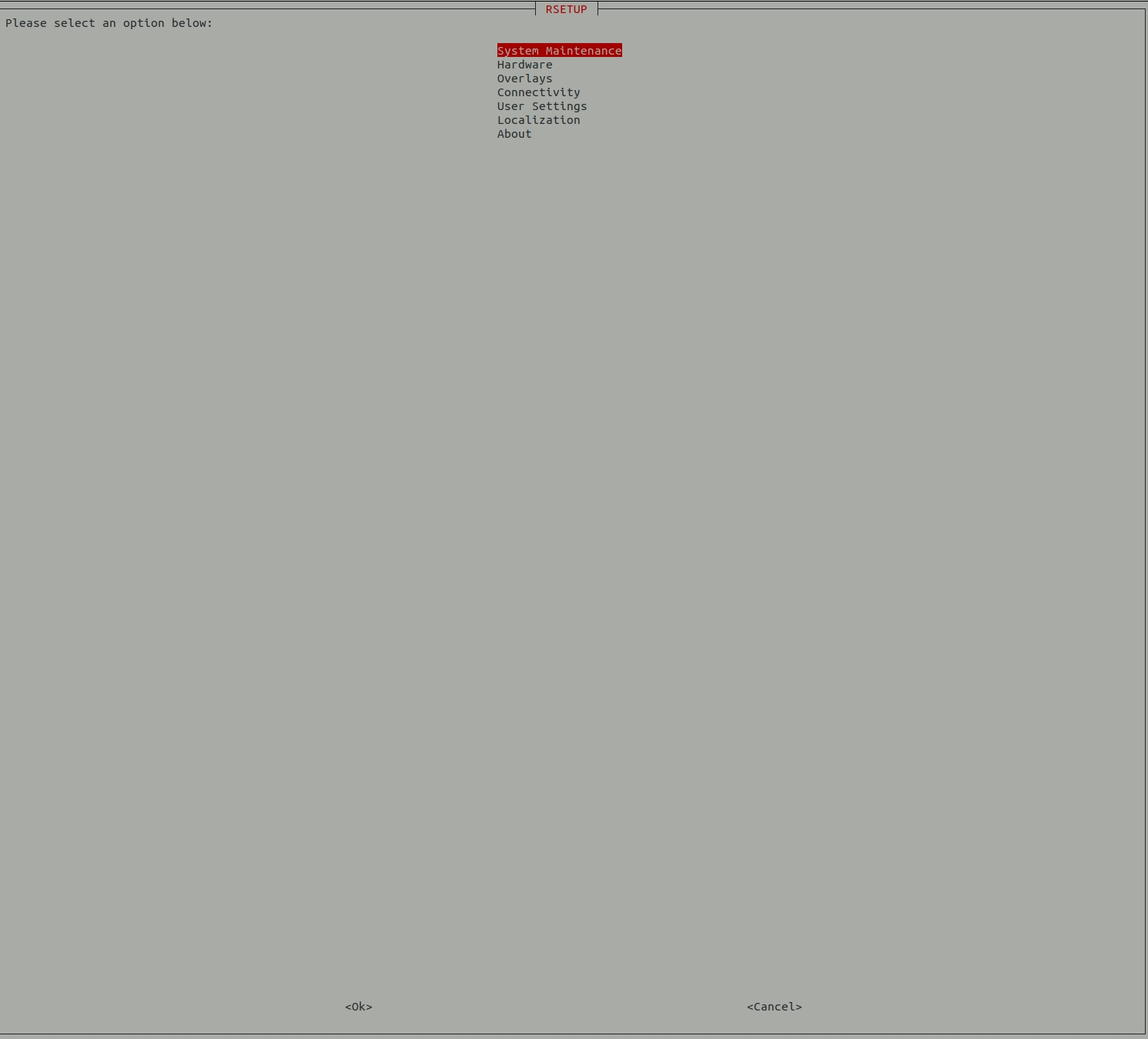
Select the third item Overlays:
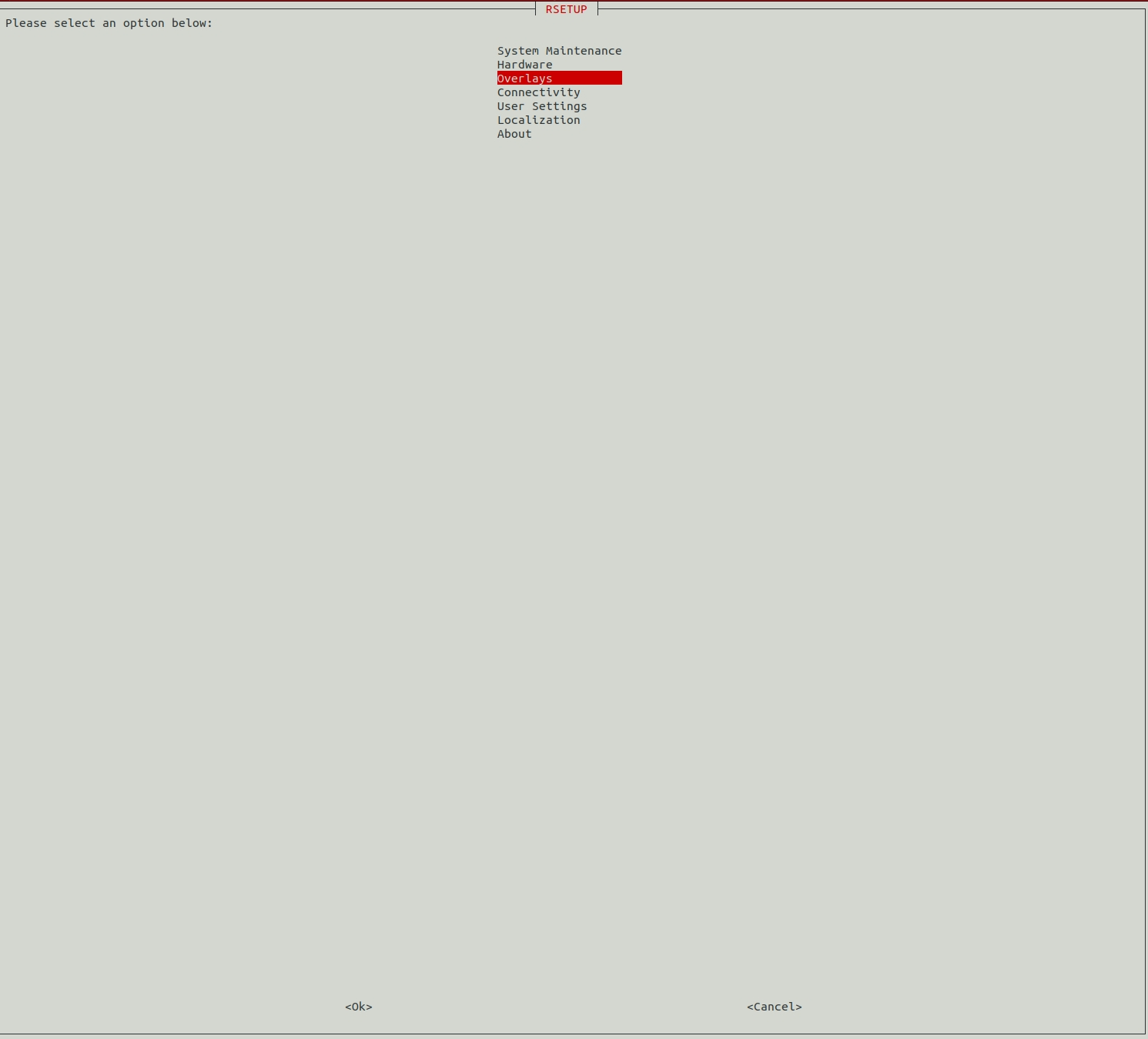
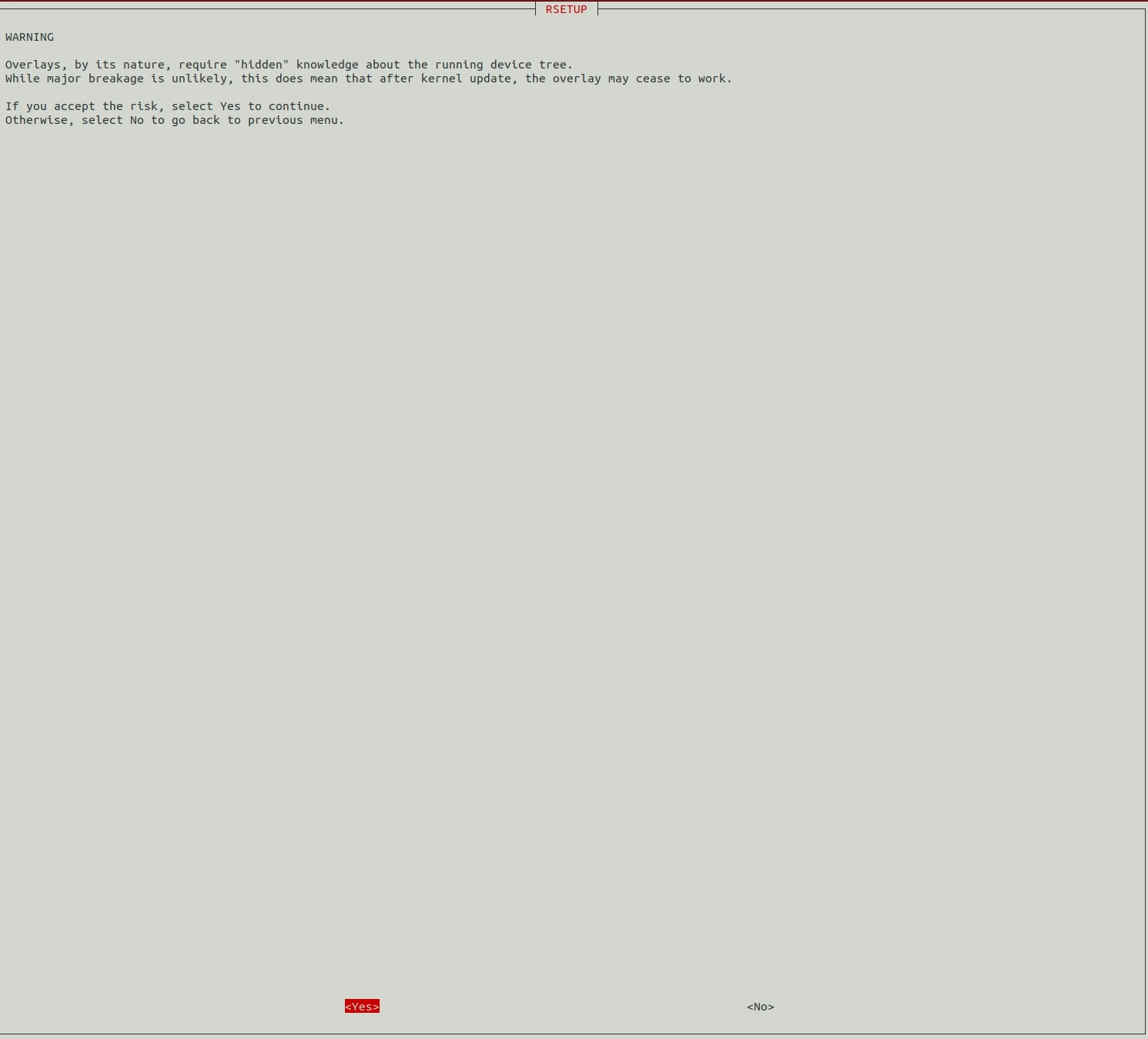
Select Yes.
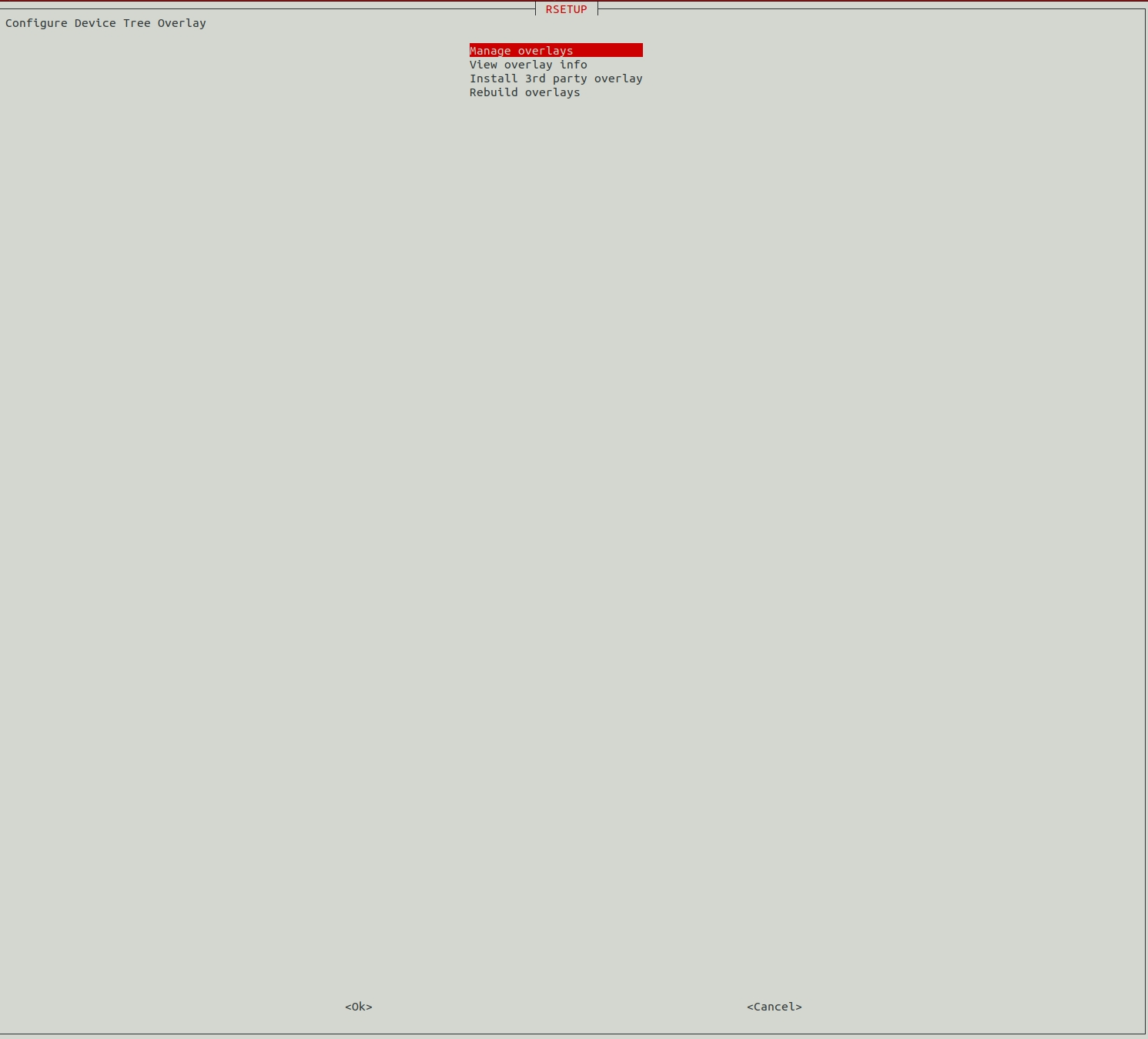
Select Manage overlays,
Press the spacebar to select the Overlay you want, a * mark when selected means it is enabled.
Here is the example of ROCK 5 ITX, different products will have different Overlay.
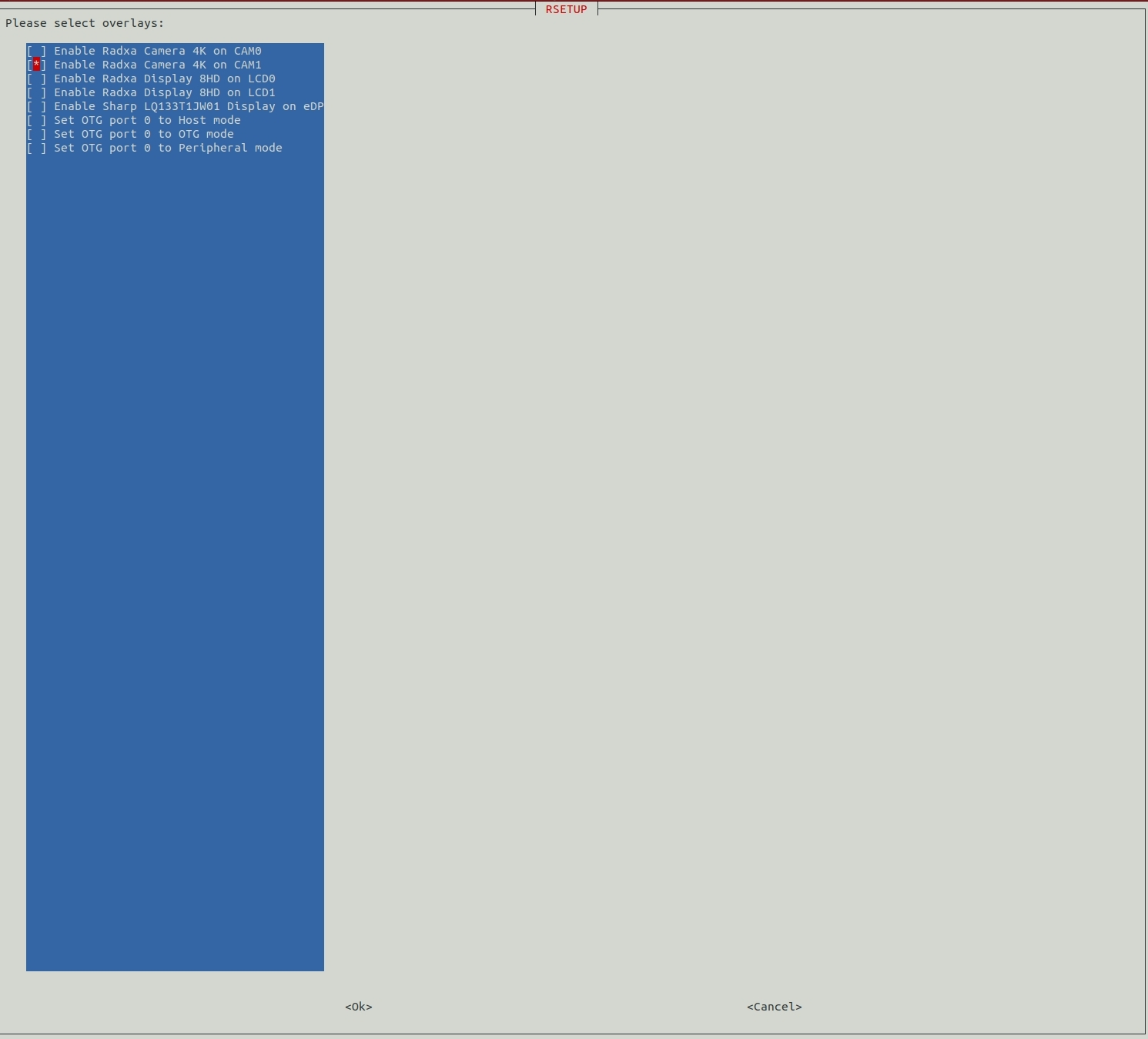
Select Yes, Overlay needs to be restarted to take effect.
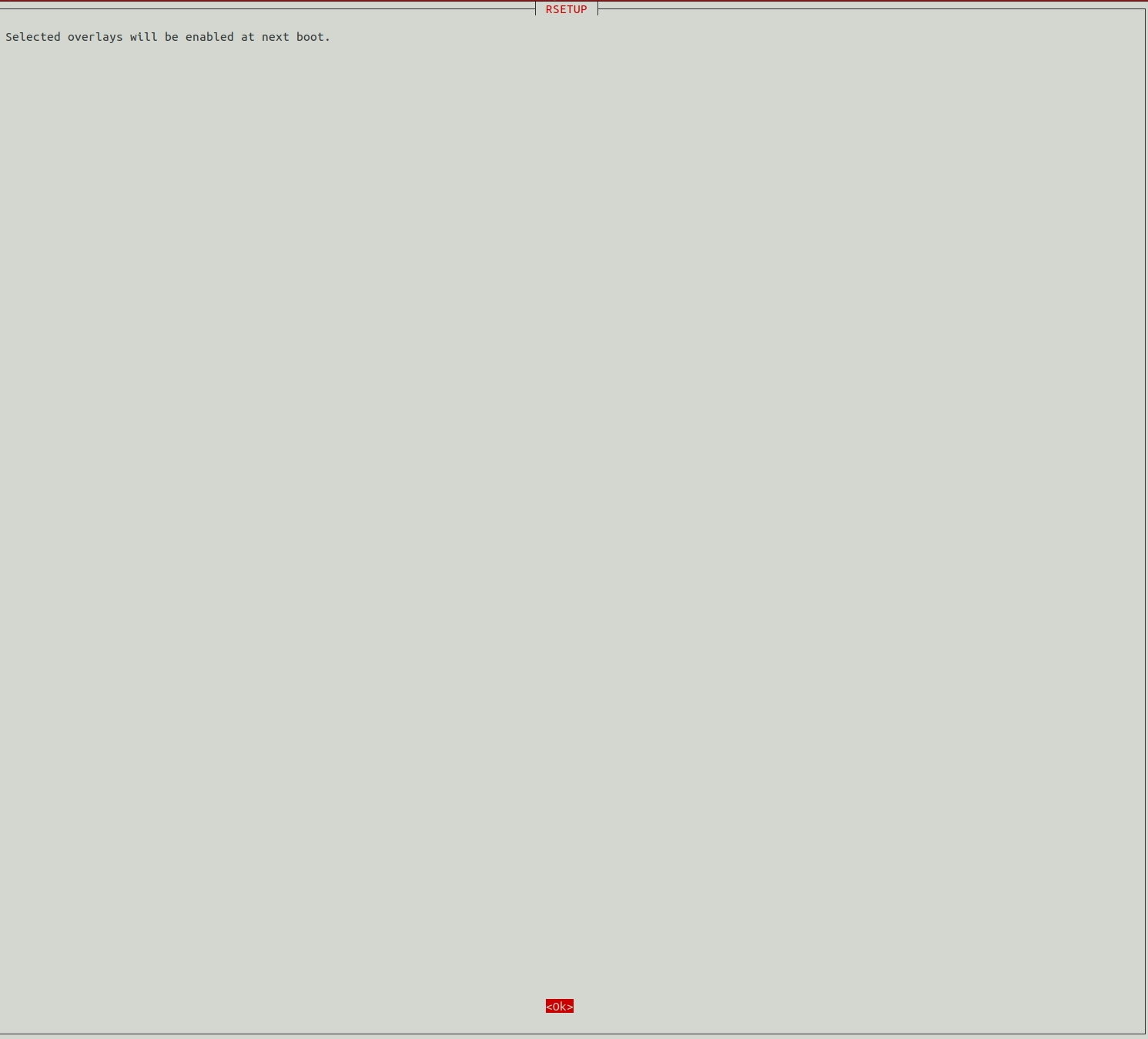
Press ESC until you exit rsetup.
Install 3rd party overlay
Install 3rd party overlay
Device Tree Overlays make it possible to support many hardware configurations with a single kernel and without the need to explicitly load or blacklist kernel modules.
You can use rsetup to manage overlays.
The Install 3rd party overlay feature of rsetup installs both device tree overlay files (DTBO) and source code (DTS).
Pre-compiled files from the official DTBO repository radxa/overlays can be downloaded from here.
Get radxa/overlays source code
git clone https://github.com/radxa/overlays.git
cd overlays
Load the overlay using rsetup
Select Overlays in rsetup's main interface:
Configure Device Tree Overlay
        Manage overlays
        View overlay info
        Install 3rd party overlay"
        Reset overlays
        <Ok>             <Cancel>
Then, select Install 3rd party overlay:
Configure Device Tree Overlay
        Manage overlays
        View overlay info
        Install 3rd party overlay
        Reset overlays


      <Ok>            <Cancel>
The following is the path to the source code of the Rexchip SOC device tree overlay file.
arch/arm64/boot/dts/rockchip/overlays/*.dts
If the SOC vendor is Amlogic, you need to replace rockchip with amlogic in the above path.
Then select the overlay you want to load, then exit rsetup, and finally reboot.
You can check the parameters using cat /boot/extlinux/extlinux.conf
Adding LEDs
Add LED
Single board computers or computing modules shipped by Radxa usually have two LEDs by default: One power light (not modifiable by software) and a system heartbeat light. If you want to have a hard disk status light or a network port status light like a PC, follow the tutorial! Using the Radxa 5B as an example, you need to modify the device tree overlay file (DTBO) according to the GPIOs used.
- Hardware connections
GPIO3_C1(PIN11)(3.3V) <----> Resistor (select size according to LED datasheet) <----> LED positive <----> LED Negative <----> GND(PIN9)
- Edit device tree overlay file (DTBO)
nano ~/user_led3.dts
The following is the content of the DTBO:
The triggers that can be used: none rc-feedback rfkill-any rfkill-none kbd-scrolllock kbd-numlock kbd-capslock kbd-kanalock kbd-shiftlock kbd-altgrlock kbd-ctrllock kbd-altlock kbd-shiftllock kbd-shiftrlock kbd-ctrlllock kbd-ctrlrlock tcpm-source-psy-4-0022-online disk-activity disk-read disk-write ide-disk mtd nand-disk cpu cpu0 cpu1 cpu2 cpu3 cpu4 cpu5 cpu6 cpu7 panic mmc2 mmc1 mmc0 default-on heartbeat pattern timer rfkill1 phy0rx phy0tx phy0assoc phy0radio rfkill2 rfkill3
/dts-v1/;
/plugin/;

#include <dt-bindings/gpio/gpio.h>
#include <dt-bindings/pinctrl/rockchip.h>

/ {
    fragment@0 {
        target-path = "/";                                      /* Primary dts node to be modified */
        __overlay__ {                                           /* Add or modify the contents of these brackets */
            custom-leds{                                        /* Add custom-leds node */
                compatible = "gpio-leds";
                status = "okay";
                microsd-led {                                   /* Add icrosd-led node */
                    gpios = <&gpio3 RK_PC1 GPIO_ACTIVE_HIGH>;   /* Register GPIO3_C1 as the enable pin of microsd-led, the enable is level-pull-high by default. */
                    linux,default-trigger = "mmc1";             /* Set default trigger to mmc1(SD Card) */
                };
            };
        };
    };
};
- Load the DTBO
rsetup

# Follow these options to access the Install 3rd party overlay interface
# Overlays -> Install 3rd party overlay
- Select user_led3.dts
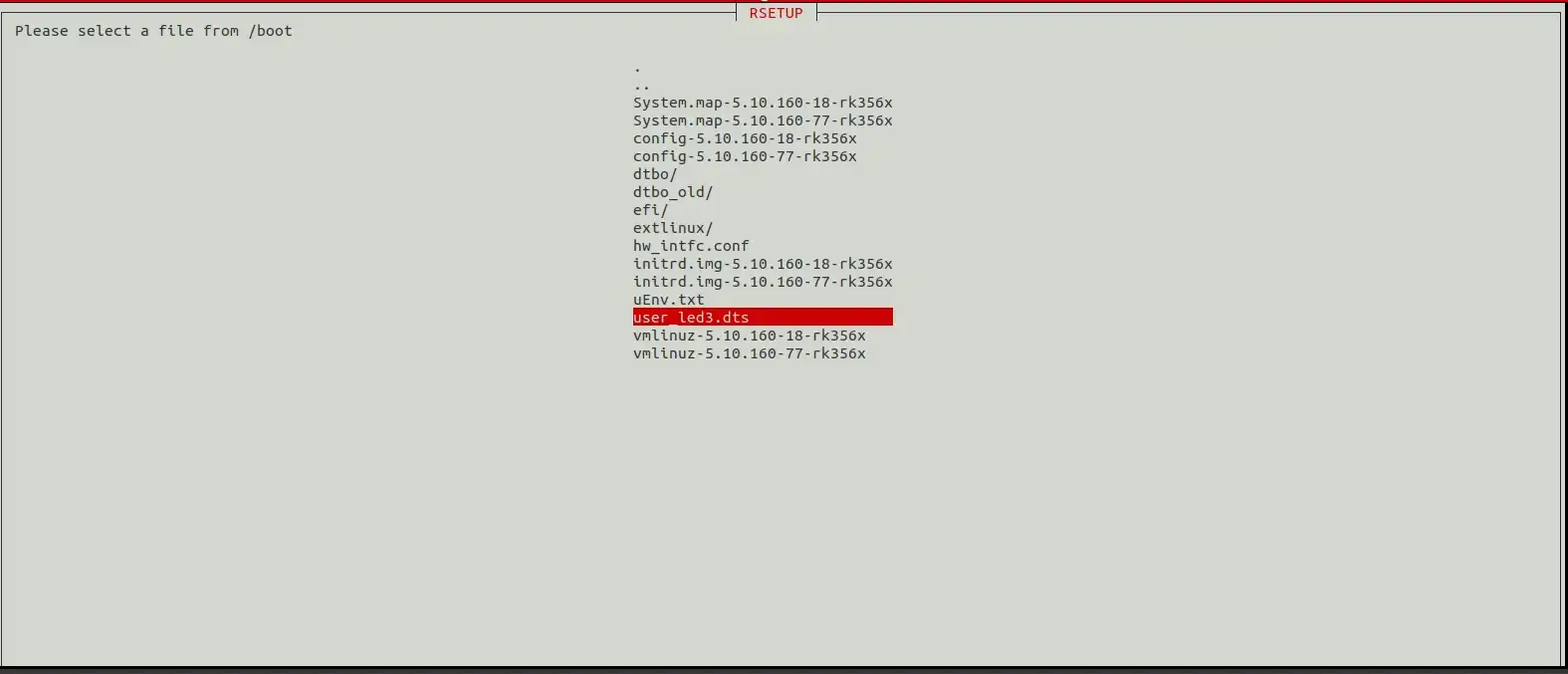
- Reboot
sudo reboot
After reboot, you can see the LEDs flashing to follow the status of the hard disk.
Configure Pins 8 and 10 as GPIOs
Configure Pins 8 and 10 as GPIOs
By default, the UART2_M0 interface is a FIQ debugging serial port, which can output logs of DDR Init, U-Boot, Linux Kernel, etc. for debugging. Therefore, it is not recommended to cancel this configuration as you can use other serial ports if not necessary.
- Disable the FIQ-Debugger configuration.
rsetup

# Follow these options to access the Manage overlays interface
# Overlays -> Manage overlays
Tick Disable FIQ Debugger.
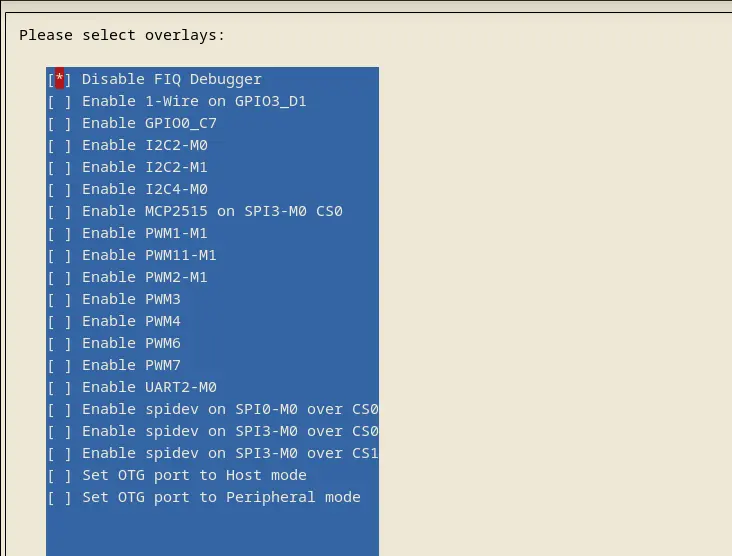
Check the box and select OK, then exit rsetup and reboot the system, PIN 8 && PIN 10 can be used as normal GPIOs.
Configure UART2_M0 as normal serial port
Configure UART2_M0 as normal serial port
By default, the UART2_M0 interface is a FIQ debugging serial port, which can output logs of DDR Init, U-Boot, Linux Kernel and other logs for debugging. Therefore, it is not recommended to cancel this configuration as you can use other serial ports if not necessary.
- Enable UART2_M0
rsetup

# Follow these options to access the Manage overlays interface
# Overlays -> Manage overlays
Tick Enable UART2-M0
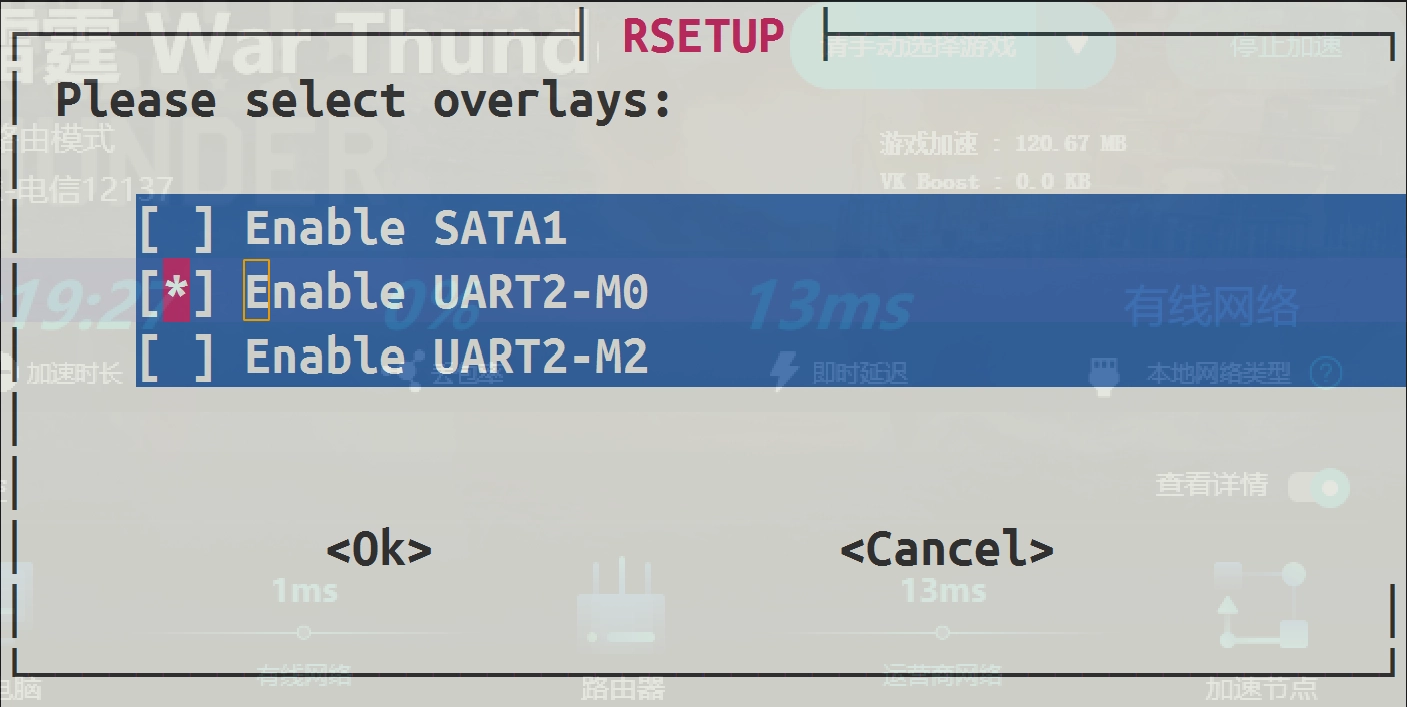
Select OK, then exit rsetup.
- Modify Linux boot parameters
Following Linux boot parameters, remove all ttyFIQ0 and ttyS2 related console parameters from the /etc/kernel/cmdline file, e.g. "console=ttyFIQ0,1500000n8".
Connectivity
This option is similar to network settings.
After selecting Network, nmtui (NetworkManager Text User Interface) will start:
┌─────────────────────────────────────────────────────────────────────────────┐
│                         NetworkManager TUI                                  │
│                                                                             │
│  Please select an option                                                    │
│                                                                             │
│  Edit a connection                                                          │
│  Activate a connection                                                      │
│  Set system hostname                                                        │
│                                                                             │
│  Quit                                                                       │
│                                                                             │
│                                  <OK>                                       │
└─────────────────────────────────────────────────────────────────────────────┘
Network management features:
Edit a connection
- Add new connections (Wi-Fi, Ethernet, VPN, etc.)
- Edit existing connection profiles
- Delete unused connections
- Configure IP address (static/DHCP)
- Configure DNS servers
Activate a connection
- View available connections
- Connect to a Wi-Fi network
- Activate or deactivate network interfaces
- Check connection status
Set system hostname
- Change the system hostname
Wi-Fi steps:
- Choose
Activate a connection - Select your Wi-Fi network
- Enter password
- Wait until connected
Ethernet steps:
- Choose
Edit a connection - Select your Ethernet profile
- Choose
Automatic (DHCP)orManual
- Use
Tabto switch between areas - Use
Enterto confirm - Use
Escto go back - NetworkManager settings usually take effect immediately
User Settings
Password
Change the password of the current user.
┌──────────────────────────────────┤ RSETUP ├──────────────────────────────────┐
│ Please enter the new password for radxa:                                    │
│                                                                              │
│ ********________________________________________________________             │
│                                                                              │
│                     <Ok>                         <Cancel>                    │
└──────────────────────────────────────────────────────────────────────────────┘
Steps:
- Enter a new password (input is masked as
*) - Confirm the new password
- If the passwords do not match, you will be prompted to re-enter
- Password should be at least 8 characters
- Use a combination of letters, numbers, and symbols if possible
- Keep your password safe; losing it may prevent you from logging in
Hostname
Change the system hostname.
┌──────────────────────────────────┤ RSETUP ├──────────────────────────────────┐
│ Please enter the new hostname:                                              │
│                                                                              │
│ radxa-rock-5b___________________________________________________             │
│                                                                              │
│                     <Ok>                         <Cancel>                    │
└──────────────────────────────────────────────────────────────────────────────┘
Hostname rules:
- Only letters, numbers and hyphens (
-) - Must not start or end with a hyphen
- Length must be <= 63 characters
Reboot is recommended after changing the hostname to ensure all services pick up the new name.
Configure auto login
If Configure auto login is missing, update the system using System -> System Update and reboot.
Configure auto login for TTY and desktop display manager.
┌──────────────────────────────────┤ RSETUP ├──────────────────────────────────┐
│ Please select the service(s) you want to enable auto login:                 │
│                                                                              │
│    [ ] [email protected]                                                    │
│    [ ] sddm.service                                                          │
│                                                                              │
│                     <Ok>                         <Cancel>                    │
└──────────────────────────────────────────────────────────────────────────────┘
Supported display managers:
getty@tty*.service: TTY auto login (CLI)serial-getty@*.service: serial console auto login- SDDM: KDE Plasma
- GDM: GNOME
- LightDM: lightweight display manager
Enabling auto login reduces system security. Only use it on personal devices or test environments.
Localization
Here you can change Timezone, Locale, Keyboard layout, and Wi-Fi Country.
Timezone
This option sets the system timezone and typically launches dpkg-reconfigure tzdata.
Example UI:
┌──────────────────────────────────┤ Configuring tzdata ├──────────────────────┐
│                                                                              │
│ Please select the geographic area in which you live.                         │
│                                                                              │
│ Geographic area:                                                             │
│                                                                              │
│              Africa                                                          │
│              America                                                         │
│              Asia                                   ▒                        │
│              Europe                                 ▒                        │
│              Etc                                    ▒                        │
│                                                                              │
│                      <Ok>                      <Cancel>                      │
└──────────────────────────────────────────────────────────────────────────────┘
Common timezones:
Asia/Shanghai(UTC+8)UTC
Locale
This option configures language/region settings and typically launches dpkg-reconfigure locales.
Example UI:
┌──────────────────────────────────┤ Configuring locales ├────────────────────┐
│ Locales to be generated:                                                    │
│                                                                              │
│    [ ] en_GB.UTF-8                                                    ▒      │
│    [*] en_US.UTF-8                                                    ▒      │
│    [ ] zh_CN.UTF-8                                                    ▒      │
│                                                                              │
│                      <Ok>                      <Cancel>                      │
└──────────────────────────────────────────────────────────────────────────────┘
Recommended locales:
en_US.UTF-8zh_CN.UTF-8
Wi-Fi Country
This option sets the Wi-Fi regulatory domain.
Why it matters:
- Different countries have different Wi-Fi channel and power limits
- Correct settings can improve compatibility and stability
Incorrect settings may cause connection issues, reduced signal strength, or regulatory violations.
Common Tasks
Quick shortcuts to perform common setup tasks.
┌──────────────────────────────────┤ RSETUP ├──────────────────────────────────┐
│ Please select all tasks you want to perform:                                │
│                                                                              │
│    [ ] Install Baota Panel                                                   │
│                                                                              │
│                      <Ok>                      <Cancel>                      │
└──────────────────────────────────────────────────────────────────────────────┘
Tasks (normal mode)
In normal mode, Common Tasks is a multi-select list.
Install Baota Panel
Installs Baota Panel (BT-Panel).
Tasks (DEBUG mode)
In DEBUG mode, Common Tasks may show a dedicated menu:
┌──────────────────────────────────┤ RSETUP ├──────────────────────────────────┐
│ Please select an option below:                                              │
│                                                                              │
│                         Baota Panel                                          │
│                                                                              │
│                      <Ok>                      <Cancel>                      │
└──────────────────────────────────────────────────────────────────────────────┘
Execution flow:
- Use
Spaceto select tasks - Choose
<Ok>to confirm - Review the task list
- Confirm again to start
- Review the output/info shown after completion
- Press
Enterto continue
- Some tasks require network access
- Do not interrupt while tasks are running
- Record important information (ports/passwords) shown by the tool
About
Information about rsetup.
Troubleshooting
rsetup fails to start
Issue: rsetup cannot start or shows a permission error
Fix:
- Make sure you run
sudo rsetupor allow the system to elevate privileges - Try setting
export TERM=xterm-256colorif your terminal type is unsupported - Try another terminal emulator
System update fails
Issue: errors occur during system update
Fix:
- Check your network connection
- Try switching APT mirrors
- Verify system time (TLS certificate checks may fail if time is wrong)
- Review error messages and ask the community for help if needed
System fails to boot after enabling an overlay
Issue: system cannot boot after enabling an overlay
Fix:
- Connect via serial console or SSH (if possible)
- Edit
/boot/config.txtor/boot/uEnv.txtto remove/comment the problematic overlay - Reboot
- If software recovery is not possible, boot from SD card and fix the configuration
Best practices
- Use
System Updateregularly to keep packages up to date - Avoid updating/erasing bootloaders unless necessary
- Understand overlays before enabling them
- Back up important data before major changes
- Keep a record of configuration changes for troubleshooting
References
- Radxa Docs: https://docs.radxa.com/
- Radxa Forum: https://forum.radxa.com/
- Radxa GitHub: https://github.com/radxa
- rsetup source: https://github.com/radxa-pkg/rsetup